What We Would Do Differently If We Started Our Display Over Today
In 2016, I found myself standing in the front yard surrounded by storage totes filled with Christmas decorations. Everything had been pulled out of storage, twelve strings of lights were already hanging, and there was still an enormous amount of work waiting to be done. It was a scene I’d experienced plenty of times before, usually with some combination of excitement, anticipation, and the occasional frustration that comes with preparing a Christmas display.
But something was different that year. I looked at the twelve strings of lights I’d hung, then turned around and looked at all the totes scattered across the lawn. For a moment, I just stood there thinking about everything that still needed to be done. Then, quite literally speaking out loud to myself, I said, “This isn’t fun anymore.”
I packed everything away and didn’t put up a display that Christmas.
Looking back, taking that year off was probably the best decision I ever made for the long-term future of Johnson’s Christmas Corner. It gave me an opportunity to reconsider how I approached something that had been part of our lives for more than a decade. More importantly, it helped me rediscover why I’d started decorating in the first place. But to understand how I reached that point, we need to go back to 2005, when everything about Christmas decorating seemed exciting and almost every idea seemed like a good one.
A Lot of Enthusiasm, Not Much of a Plan
When we started decorating our home in Cypress, Texas, I was 33 years old and had a pretty simple vision. I thought our house would look terrific covered in Christmas lights, and I wanted to make that happen. What I didn’t have was a particularly well-developed plan for how everything should come together, how much I should reasonably spend, or what the finished display was actually supposed to look like.
Instead, I bought things. Lots of things. If I came across a decoration that looked interesting, there was a pretty good chance it would end up coming home with me. Whether I had a place for it, whether it complemented anything else, or whether I had any realistic intention of using it seemed to be secondary considerations. I was enthusiastic about the possibilities, and purchasing something new felt like another step toward creating the display I imagined.
The problem was that I wasn’t always imagining a complete display. More often, I was imagining individual decorations and effects without giving enough thought to how they would work together. I’d see something interesting and immediately start thinking about how I could use it, rather than considering whether it actually contributed to what I was trying to accomplish. Over time, that approach became expensive, and it also created a collection of things that didn’t necessarily have a purpose.
If I were starting over today, I’d approach those early purchases very differently. Before buying anything, I’d spend more time looking at the house and yard, thinking about how the different areas could work together, and developing a general vision for what I wanted to create. That doesn’t mean I’d need a detailed drawing showing the exact location of every light or decoration, but I would want some sense of direction before reaching for my wallet.
I’d also remind myself that there was absolutely no reason to accomplish everything in the first year. One of the advantages of Christmas decorating is that the display can grow and change over time. An idea that seems exciting today might become a project for next season, or perhaps several seasons down the road. There’s nothing wrong with that, particularly when taking your time allows you to do something better rather than simply doing it sooner.
The Value of Learning From Other Decorators
While there are plenty of things I’d change about those early years, one thing I’d absolutely do again is connect with other people who share an interest in Christmas decorating. I met a tremendous number of people through online communities and events, and I took every opportunity to ask questions, listen to their experiences, and learn how they approached their displays.
Some people were particularly knowledgeable about equipment and technology, while others had an incredible eye for design or a creative approach to building decorations. I learned from all of them, even when their methods or preferences were different from my own. Sometimes I’d take an idea and use it almost exactly as someone else had. Other times I’d modify it to fit our display, and occasionally I’d decide that an approach simply wasn’t something I wanted to pursue.
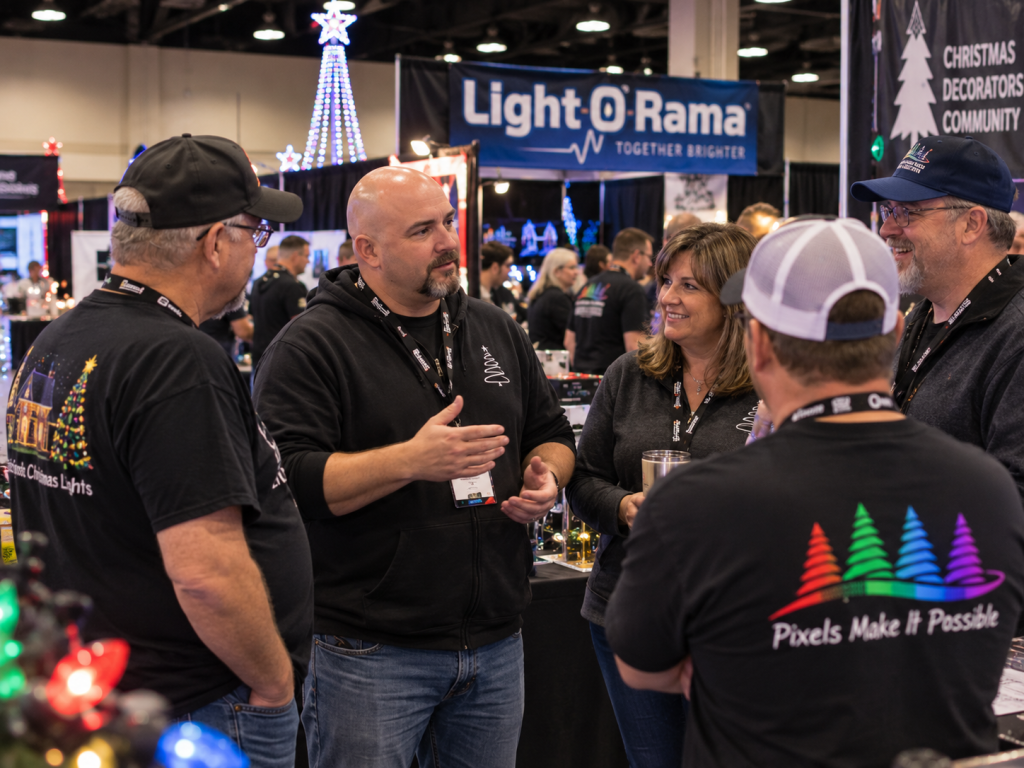
I never saw anything wrong with borrowing a good idea. Christmas decorating is a hobby filled with people who experiment, share their successes, and occasionally explain why something that looked wonderful on paper turned into a complete disaster in the yard. Being willing to listen to those experiences can save an enormous amount of time and frustration, and it can also introduce you to possibilities you might never have considered on your own.
What I would change is how I sometimes responded to seeing other displays. It’s easy to admire something another decorator has created and immediately start thinking about how you can add the same thing to your own yard. Before long, you can find yourself pursuing ideas simply because someone else has done them successfully, rather than because they fit your particular vision.
There’s an important difference between allowing someone else’s creativity to inspire you and allowing their display to determine what yours should become. I still believe one of the best things a new decorator can do is meet other people involved in the hobby and learn as much as possible. Just remember that listening to everyone doesn’t mean you have to do everything they suggest.
When More Became the Goal
As Johnson’s Christmas Corner grew, I found myself becoming increasingly interested in making everything bigger. I wanted more lights, more decorations, more songs, and, naturally, more people coming to see the finished display. It wasn’t necessarily a conscious decision to compete with anyone, but I had developed a mindset in which adding more seemed like the obvious way to make things better.

Music became a particularly enjoyable part of the experience after we began using Light-O-Rama to synchronize our lights. I discovered that I loved selecting songs and imagining how different parts of the music could translate into lighting effects. Sometimes I’d spend months listening to a particular song before ever beginning the sequencing process, thinking about the possibilities and developing ideas for how I wanted the lights to respond.
That creative process is something I still enjoy, and I wouldn’t want to change it. For me, sequencing has never been simply about adding another song to the playlist. There’s something satisfying about listening to a piece of music, imagining what you want to accomplish visually, and gradually turning those ideas into something that works in the yard.
But in other areas, I often took on more than I could reasonably accomplish. New equipment, new decorations, and new ideas were always tempting, especially as technology made increasingly elaborate effects possible. Sometimes I was so focused on what I could add that I wasn’t giving enough consideration to whether I had the time, resources, or even the desire to see everything through.
And despite having more than twenty years of experience, I can assure you that I’m not entirely immune to this problem today. We purchased two Light-O-Rama pixel packages with the intention of building a pair of mega pixel trees. Every year, I confidently announce that this will finally be the season those trees become part of the display. So far, they’ve managed to remain safely out of sight, waiting for their big debut.
I suppose the difference today is that I’m comfortable admitting those trees might have to wait another year. The equipment isn’t going anywhere, and forcing a project into the schedule simply because I already purchased the materials doesn’t make much sense. There was a time when I might have felt compelled to get them built regardless of how much additional work it created. These days, I’m much more willing to let a good idea remain a future project until I’m ready to enjoy the process of bringing it to life.
The Christmas We Took Off
By the time 2016 arrived, decorating had become increasingly demanding. There was always another project I wanted to finish, something new I hoped to introduce, or an improvement I felt needed to be made before the season began. Over the years, I’d placed a tremendous amount of pressure on myself to meet deadlines that, when you really think about it, were largely arbitrary.

Nobody was requiring me to introduce new decorations every year, and there certainly wasn’t anyone standing in the driveway demanding that every last light be installed by a particular date. Those expectations were largely ones I’d created for myself, but that didn’t make them feel any less real when I was staring at everything that still needed to be done.
Eventually, that pressure caught up with me. Standing in the yard in 2016, looking at the twelve strings of lights and all those storage totes, I realized I wasn’t looking forward to finishing the display. I was looking at the amount of work ahead of me and feeling something closer to dread than excitement. That was when I decided I’d had enough for the year.
Taking the season off wasn’t part of some carefully considered plan to change my approach to decorating. I was simply burned out, and I needed a break. What surprised me was how valuable that break turned out to be. Without the usual preparation, deadlines, and responsibilities, I had an opportunity to step away from the routine and remember what I actually enjoyed about the hobby.
And somewhere along the way, I discovered that I missed it.
When I returned to decorating in 2017, I made a conscious decision that things were going to be different. I wasn’t going to worry about meeting some arbitrary deadline, introducing new features simply for the sake of having something new, or allowing visitor traffic to determine whether the season had been successful. I wanted to create a display I enjoyed building, and I wanted the experience of putting it together to be something I looked forward to again.
That change in attitude didn’t eliminate the work involved. Christmas displays still require planning, maintenance, troubleshooting, and plenty of time spent outside when you’d probably rather be sitting somewhere comfortable. But there’s a significant difference between doing that work because you’re excited about what you’re creating and doing it because you’ve convinced yourself that you have no choice.
Rethinking What Makes a Display Successful
One of the biggest changes in my thinking involved the way I measured success. During those earlier years, I paid considerable attention to the number of people who visited Johnson’s Christmas Corner. I wanted large crowds, and when traffic didn’t meet my expectations, I sometimes found myself disappointed despite all the work we’d put into creating the display.
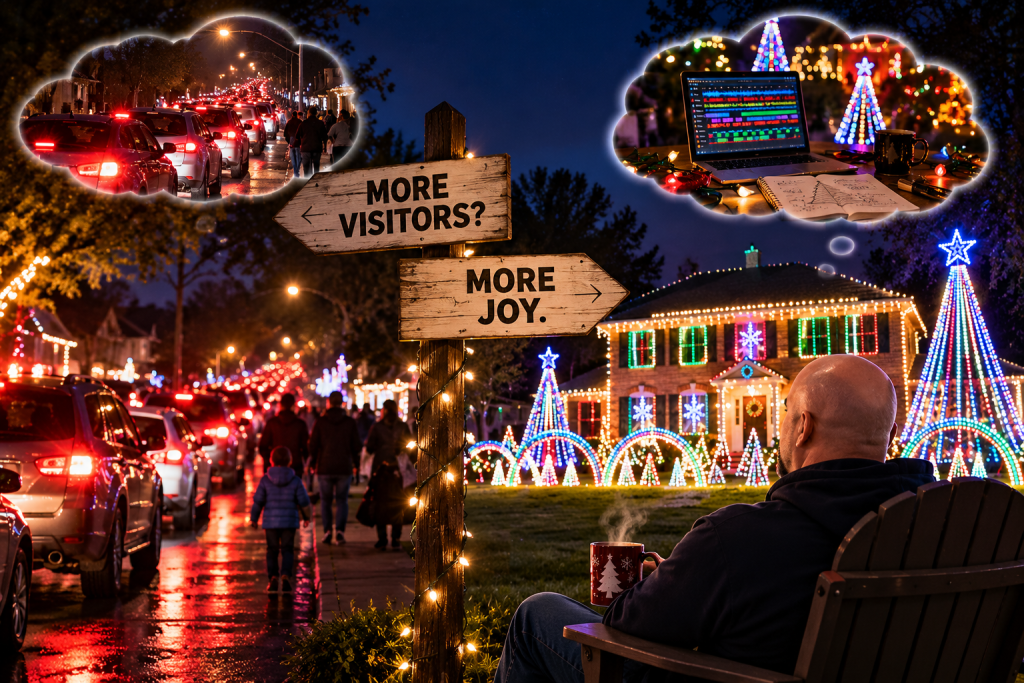
There’s something rather strange about that when you consider what we’re actually doing. We decorate our home because we enjoy Christmas, we enjoy creating something interesting, and we want to share that experience with others. Yet it’s remarkably easy to become so focused on how many people show up that you lose sight of whether you’re enjoying what you’ve created.
I still love seeing families visit Johnson’s Christmas Corner, particularly those who return year after year and have made our display part of their holiday traditions. It’s rewarding to know that something we enjoy doing has become something other people look forward to as well. But I’ve also learned that visitor numbers aren’t necessarily a reliable measure of how successful a display has been.
In fact, the enormous crowds I once hoped for can create problems of their own. When cars begin lining up down the block, traffic becomes something you have to think about, particularly when your display is located in a residential neighborhood. More visitors can certainly be exciting, but they also bring responsibilities and complications that aren’t always obvious when you’re wishing more people would stop by.
Today, I approach things differently. I create the display I want to create, spend time on the projects that interest me, and enjoy seeing everything come together. If people visit, that’s wonderful, and I’m glad they’re able to enjoy what we’ve built. If fewer people come by, that doesn’t somehow diminish the display or make the work less worthwhile.
I’ve learned that I can’t control how many people decide to visit, and there’s little sense in allowing something outside my control to determine whether I’m satisfied with a hobby I genuinely enjoy.
What I’d Tell Someone Starting Today
If someone came to me tomorrow with $500 and asked how they should get started decorating their home for Christmas, my first recommendation wouldn’t involve a particular brand of lights, a controller, or any other piece of equipment. I’d encourage them to think about what they actually wanted to create and how much they could reasonably accomplish with the time and resources available.

I’d also encourage them to think beyond their first Christmas season. Maybe the display they’re imagining will take several years to build, and that’s perfectly fine. Start with something manageable, learn from the experience, and allow the display to develop over time. There’s no requirement that every idea become reality immediately, and attempting to accomplish too much at once is one of the easiest ways to turn an enjoyable project into an exhausting one.
I’d caution them against purchasing everything that looks interesting, because I know firsthand how quickly those purchases can accumulate. I’d also suggest considering what they might be able to make themselves instead of automatically buying something ready-made. Building your own decorations can be a rewarding part of the hobby, and it gives you an opportunity to create something that fits your particular vision rather than trying to make your vision fit whatever happens to be available in a store.
Most importantly, I’d tell them not to compare their display to someone else’s or approach decorating as a competition they need to win. There will always be another house with more lights, more sophisticated equipment, or a larger budget. If you’re decorating primarily to win the neighborhood Christmas contest, you may find yourself making decisions based on what you think will impress other people rather than what you actually enjoy.
There’s nothing wrong with wanting to create something impressive, and there’s certainly nothing wrong with being proud when other people appreciate your work. But those things should be the result of creating something you enjoy, not the reason you’re doing it in the first place.
Looking Back, and Looking Ahead

Sometimes I think about the excitement I felt when we first started decorating in 2005. Everything seemed possible, every new decoration was another opportunity, and I couldn’t wait to see what we might create. That enthusiasm was genuine, and even knowing what I know today, I wouldn’t want to lose it.
Of course, I was 33 years old then, and I’m 53 now. Life has changed considerably over those years, and so have my interests, priorities, and expectations. I don’t necessarily think the way I approached decorating back then was better or worse than the way I approach it today. It was simply different, shaped by where I was in life and what I was discovering at the time.
If I could start over with the experience I have now, I’d certainly make some different decisions. I’d plan more carefully, spend more wisely, and give myself permission to develop the display over several seasons rather than trying to accomplish everything at once. I’d spend less time worrying about how our display compared to others and more time concentrating on the creative possibilities that made me interested in decorating in the first place.
But I wouldn’t change the people I met, the ideas I discovered, or the enjoyment I found in experimenting with things I’d never tried before. Even the purchases that didn’t work out and the projects that never quite came together taught me something along the way. Those experiences are part of how Johnson’s Christmas Corner became what it is today.
And I wouldn’t change the decision I made in 2016, either. At the time, packing everything away felt like walking away from something that had been important to me for years. In reality, stepping away for a season was what allowed me to come back with a much healthier perspective and a renewed appreciation for the hobby.
After more than twenty years, I still have ideas I want to explore, decorations I’d like to build, and, apparently, a couple of pixel trees that are determined to remain on the drawing board. I hope that curiosity never goes away, because imagining what might be possible next is still one of my favorite parts of Christmas decorating.
The difference is that these days, I’m perfectly happy taking my time getting there.
Watch for Our Next Article:
“The One Thing Every Great Christmas Display Has”