The Psychology of Christmas Lights:
Why People Slow Down, Smile, and Stay
Have you ever noticed what happens when people come across a really good Christmas light display? They slow down, sometimes to the annoyance of the drivers behind them. Kids press their faces against car windows, parents start pointing things out, and people who were probably headed somewhere suddenly decide they have a few minutes to spare. Some will pull over and get out for a closer look, while others are perfectly happy sitting in their cars watching the lights. Whatever they were doing before they arrived, something about those decorations was interesting enough to interrupt it.
I’ve always found that fascinating. After all, we’re talking about Christmas lights and decorations. Strings of lights, plastic figures, maybe some animation, music, and artificial snow thrown into the mix. None of those things is particularly extraordinary on its own, yet put them together in someone’s front yard and people will travel miles to see them. Some will even make the same trip year after year, often bringing their children or grandchildren along.
So what is it about Christmas lights that makes us react this way? Why do certain displays grab our attention while others barely get a second glance? And why will some people sit through several songs or spend twenty minutes looking around a display when they’ve probably seen most of it within the first few minutes? As it turns out, there’s quite a bit of psychology involved. Nostalgia, anticipation, curiosity, visual attention, and our connections with other people can all influence how we experience Christmas lights. Understanding these things isn’t necessarily going to make you a better decorator overnight, but it might help explain why some of the simplest displays can be just as memorable as the ones with hundreds of thousands of lights.
There’s Something About Light
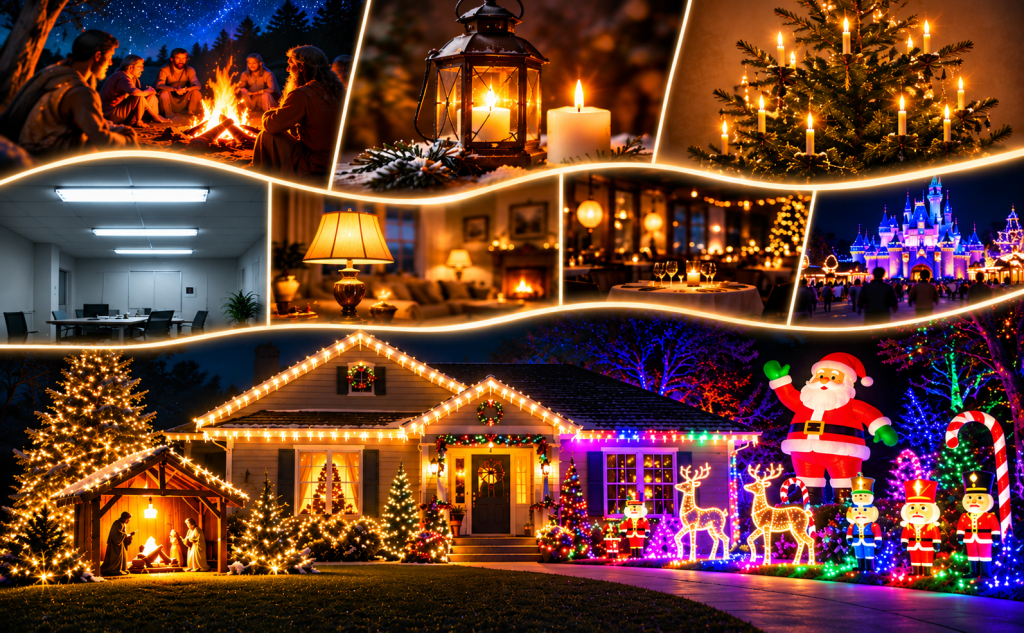
People have been gathering around sources of light for thousands of years. Fire provided warmth, protection, and a place for people to spend time together after dark. Candles and lanterns eventually became part of celebrations and traditions, and long before electric Christmas lights existed, people were decorating their Christmas trees with candles. Of course, our relationship with lighting has changed quite a bit since then, but the way lighting influences our surroundings is still very much a part of everyday life.
Think about the difference between walking into a room illuminated by harsh fluorescent lighting and one lit by a few warm lamps. Both provide enough light to see, but the atmosphere feels completely different. Restaurants, hotels, and theme parks understand this and use lighting to help create the experience they want their guests to have. The brightness, color, placement, and even the direction of the lighting can influence how we perceive a particular space.
Christmas displays work much the same way. A house outlined in warm white lights might create a cozy, traditional Christmas atmosphere, while a yard filled with colorful lights and animated characters can generate excitement. A softly illuminated nativity scene may encourage someone to stop and reflect, while a giant dancing Santa might have them laughing before they’ve even gotten out of the car. Neither approach is necessarily better because they’re creating different experiences. What matters is how the decorations work together and the atmosphere they create.
This also helps explain why the number of lights doesn’t always determine how impressive a display will be. We’ve all seen houses covered in thousands of lights that somehow don’t have much of an impact, while another house with considerably fewer decorations looks absolutely beautiful. Sometimes it’s not about how many lights you have, but how you’re using them.
Nostalgia Plays a Bigger Role Than You Might Think
If there’s one thing Christmas has plenty of, it’s nostalgia. Certain songs, decorations, colors, and traditions can bring back memories of people and places we haven’t thought about in years. Maybe it’s the kind of lights your parents used on the Christmas tree, a particular decoration your grandparents had in their yard, or a song that always seemed to be playing when you were growing up.
Psychologists have studied nostalgia for years, and research suggests it can strengthen feelings of belonging and connection with other people. That makes sense when you think about how many of our Christmas memories involve family, friends, and traditions we’ve enjoyed throughout our lives. When we see something familiar in a Christmas display, we may be responding to much more than the decoration itself. We’re also remembering the people and experiences we associate with it.
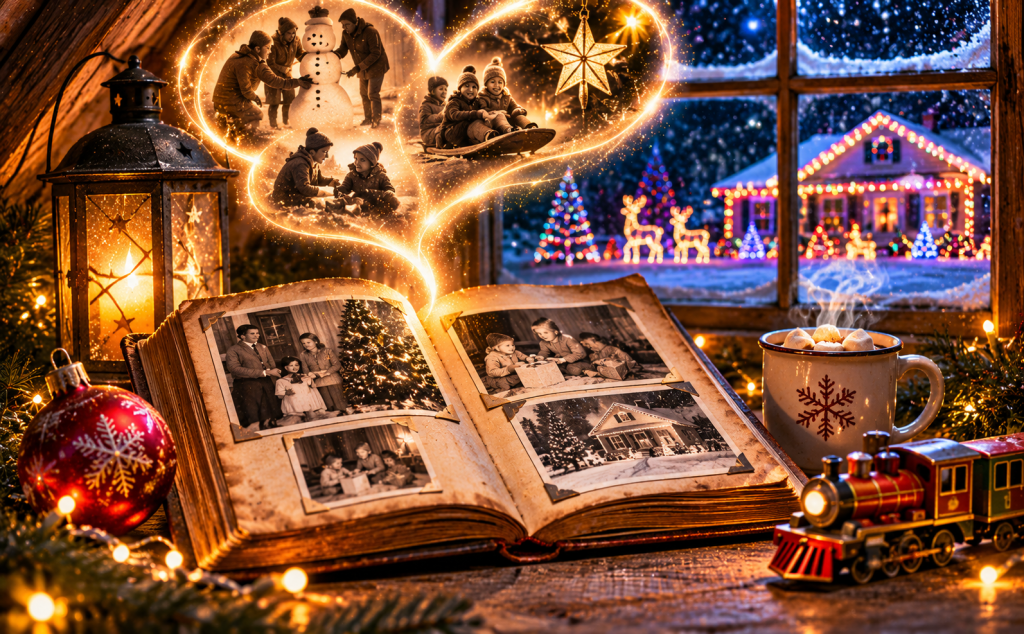
Take those old illuminated plastic Santas that were popular decades ago. By today’s standards, they’re not particularly impressive. The lighting is often uneven, the colors aren’t always very vibrant, and some of the designs look a little crude compared with what we can buy today. But put one in a Christmas display and you might be surprised how many people smile when they see it. For some visitors, that Santa might remind them of the one their parents put on the front porch every Christmas. Someone else might remember seeing one in their grandparents’ yard when they were a child. The decoration itself hasn’t changed, but what it means to the person looking at it can be entirely different.
I think that’s something worth remembering as Christmas decorating technology continues to advance. Today we have individually controlled pixels that can change colors, create elaborate animations, and synchronize with music. The possibilities are incredible, and I’m certainly not suggesting we stop taking advantage of them. But just because we can create something more sophisticated doesn’t mean those older decorations have lost their appeal.
At Johnson’s Christmas Corner, we’ve watched Christmas decorating evolve considerably over the years. We started long before pixels became commonplace and have continued adding new technology as it became available. But I’ve never believed that newer automatically means better. There’s a place for the latest technology and a place for traditional decorations, especially when those older pieces help create the familiar Christmas atmosphere people remember.
Anticipation Is Part of the Experience
Something similar happens when we’re driving through a neighborhood looking at Christmas lights. Imagine turning onto a residential street and noticing a glow in the distance. At first, you can’t really make out what’s there, but as you get closer, individual decorations begin to appear. Maybe you notice an illuminated tree, then a row of candy canes, and finally the entire display comes into view. By the time you reach the house, you’ve already spent a little time wondering what you’re going to see.
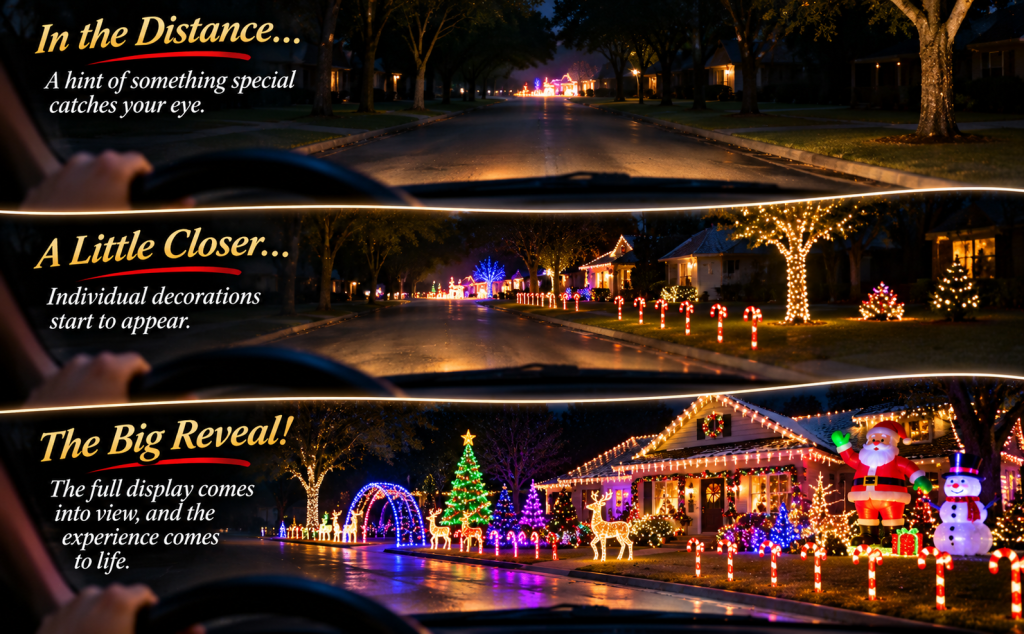
Now compare that with a display where everything is immediately visible and there’s nothing else to discover. You might still enjoy it, but the experience is different because there hasn’t been that gradual buildup of interest. This is something we can use when designing our displays without necessarily spending more money. Think about what people see when they first approach your property. Is there something that immediately catches their attention? Does the arrangement encourage them to look around, or does everything appear as one large collection of decorations?
Of course, most of us decorating residential properties can’t control the direction visitors approach from. Some people may be driving past in one direction, while others are coming from the opposite side of the street. We also have to recognize that not everyone will stop, and some visitors may only have a few seconds to take everything in. But we can still think about how the different areas of our displays work together. Even a small yard can have a focal point that attracts attention and smaller details that encourage people to keep looking.
Why Filling Every Space Isn’t Always a Good Idea
I’ll admit that this is something I have to remind myself of when decorating. There’s always another decoration I’d like to add, another lighting effect I want to try, or some empty space in the yard that looks like it could use a little something. The problem is that just because we have room for another decoration doesn’t necessarily mean we need one.
Our brains can only process so much visual information at one time. We naturally pay more attention to certain objects, particularly those that stand out because of their brightness, color, size, or movement. When everything is trying to grab our attention at once, it becomes more difficult to appreciate individual elements.
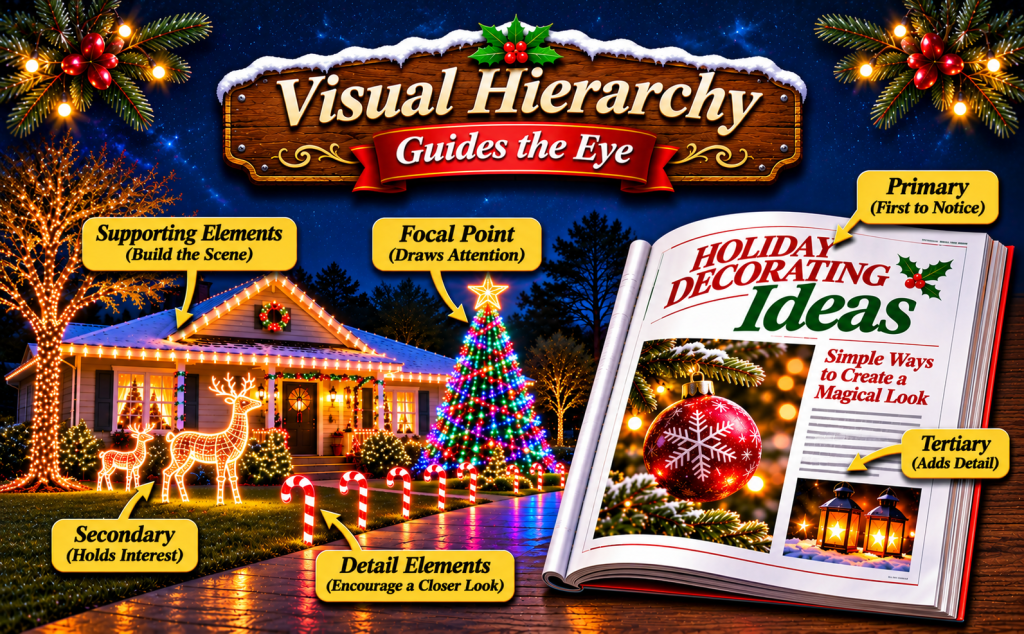
Designers use something called visual hierarchy to help organize what people see. Think about the layout of a magazine page. There’s usually a large headline, a prominent photograph, and smaller text arranged in a way that guides your eyes through the page. If everything were the same size and competing for attention, it would be difficult to know where to look first. Christmas displays can benefit from the same idea.
Maybe you have a large illuminated Christmas tree that serves as the centerpiece of your yard. Smaller decorations can complement that tree rather than compete with it. A row of candy canes might lead someone’s attention toward another part of the display, or a slightly darker area might help a brightly illuminated decoration stand out. This doesn’t mean you should only have a few decorations. I love seeing houses absolutely packed with Christmas lights, and some of the most entertaining displays are wonderfully extravagant. There’s nothing wrong with that approach as long as the individual elements still have an opportunity to be appreciated.
Sometimes moving a few decorations around or lowering the brightness of certain lights can make a surprisingly big difference. You might even discover that something you’ve had in your yard for years suddenly becomes more noticeable because it isn’t competing with everything around it.
Music Gives People Something to Look Forward To
When we first started animating our Christmas lights to music at Johnson’s Christmas Corner in 2007, it completely changed what we could do with our display. Instead of simply turning lights on and leaving them illuminated, we could coordinate them with music, create different patterns, and build sequences that changed throughout a song.
What makes musical animation interesting is the relationship between what people hear and what they see. Music naturally creates expectations. We recognize rhythms, anticipate changes, and often know when a familiar song is approaching a dramatic moment. When the lighting follows those changes, the two experiences reinforce one another.
Let’s say a Christmas song begins with a quiet piano introduction. You might illuminate only a few decorations, perhaps having them respond to individual notes. As additional instruments join in, more sections of the display become active. Then, when the music reaches its climax, the entire display comes alive. Compare that with having every light flashing continuously from the beginning of the song to the end. There’s certainly plenty of activity, but there’s much less variation for the viewer to appreciate. The lights aren’t really helping tell the musical story because everything is happening at once.
This is something that becomes increasingly apparent as you spend time sequencing Christmas lights. Just because we can make every light do something doesn’t mean we should. A quiet passage, a brief pause, or a moment when only one section of the display is active can make the next big lighting effect considerably more impressive. For example, music also gives visitors a reason to stay longer. They might recognize the song that’s playing, but they don’t necessarily know how the display will interpret it. When that song ends, they may want to see what happens during the next one. Each new sequence offers another opportunity for something different, even when they’re watching the same decorations. It’s that combination of familiarity and surprise that can keep people sitting in their cars long after they originally planned to leave.
Sometimes Watching Other People Is Half the Fun
There’s another interesting part of visiting a Christmas display that doesn’t have much to do with the decorations themselves. It’s the way people react to one another. If you’ve ever watched a group of children enjoying Christmas lights, you’ve probably noticed how quickly their excitement can spread. One child points something out, another starts laughing, and suddenly everyone is looking in the same direction. Before long, the parents are smiling too, and sometimes they’re spending more time watching their children than they are watching the actual display.
Psychologists have a term called emotional contagion, which describes how emotional expressions and reactions can influence the people around us. We experience this in all kinds of situations, from concerts and sporting events to simply spending time with people who are excited about something. Christmas displays provide a particularly good opportunity for these shared experiences because so many people visit them with family and friends.
Think about a grandparent taking a young grandchild to see Christmas lights. The grandparent may have seen hundreds of displays over the years, but watching that child discover something wonderful can make the experience feel entirely new. The enjoyment isn’t coming only from the decorations. It’s also coming from seeing someone they love having such a good time.
I suspect this is one of the reasons certain displays become annual family traditions. People remember the lights, but they also remember who they were with, the excitement of their children, and the time they spent together. As decorators, we can’t control those personal experiences, and we shouldn’t try to. What we can do is create an environment that gives people an opportunity to enjoy those moments together.
Why People Want to Take Pictures
Spend enough time around Christmas displays and you’ll notice how frequently people stop to take photographs. Sometimes they’re photographing a particularly impressive decoration, but just as often they’re taking pictures of their children, friends, or family members standing in front of the lights.
There’s a difference between those two types of pictures. A photograph of the display preserves what the decorations looked like, while a picture of your family standing in front of them preserves a memory of being there together. Those photographs also allow people to revisit the experience long after Christmas is over. They might share them with relatives, post them online, or look back at them years later when their children are older. A Christmas display that someone visited for only a few minutes can end up becoming part of their family’s collection of holiday memories.

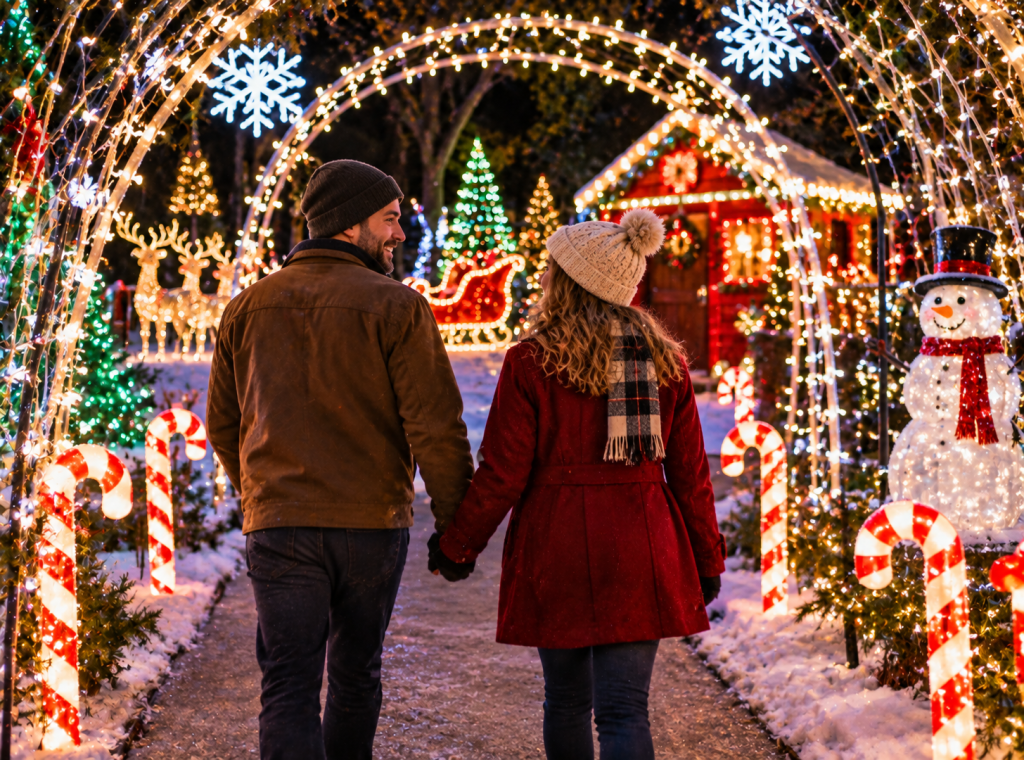
That’s something worth considering when arranging your decorations, particularly if you have a display where visitors can safely walk through certain areas. An illuminated archway, a nicely decorated Christmas tree, or a grouping of familiar characters can provide a natural place for people to stop and take pictures. You don’t have to build an elaborate photo booth or dedicate a large portion of your yard to it. Sometimes all that’s needed is an attractive arrangement of decorations with enough room for people to stand together.
There’s something pretty satisfying about knowing that a decoration you’ve spent time building or arranging might end up in someone’s family photographs for years to come.
There’s a Difference Between Awe and Being Overwhelmed
We’ve all seen Christmas displays that made us stop and stare. Sometimes it’s because of their enormous size, while other times it’s a relatively simple scene that’s so beautifully arranged that it catches us completely by surprise.
Psychologists use the term awe to describe an emotion we can experience when encountering something extraordinary. Research into awe often identifies two important characteristics: a sense of vastness and an experience that challenges our usual way of understanding something. That doesn’t necessarily mean an object has to be physically enormous. Beauty, complexity, and unusual experiences can also create that feeling. I think this is particularly interesting when it comes to Christmas decorating because we sometimes confuse overwhelming people with impressing them.
A house covered in an enormous number of lights might certainly attract attention, but that doesn’t automatically mean visitors will find it beautiful or memorable. If every decoration is flashing, every color is changing, and every part of the display is demanding attention, the experience can become exhausting rather than enjoyable.
Now imagine walking through a relatively small area with hundreds of tiny lights suspended overhead. The surrounding area is dark, the lighting is soft, and the entire scene feels completely different from what you’d normally expect to see in someone’s backyard. That experience might be just as memorable as a massive animated display, even though it uses a fraction of the equipment.
Contrast plays a big role here. A brightly illuminated decoration stands out more when the surrounding area is darker. A dramatic musical finale becomes more impressive when it follows a quieter passage. Even a simple change in brightness can create a different atmosphere without adding a single new decoration. This is why I think it’s worth experimenting with turning some lights down or even turning them off occasionally. We spend so much time figuring out how to add more lighting to our displays that we sometimes forget how effective a little darkness can be.
Why People Keep Coming Back
Here’s something else I’ve always found interesting. If people only enjoyed Christmas displays because they wanted to see something new, there wouldn’t be much reason to visit the same display year after year. Once you’ve seen it, you already know what to expect. Yet countless families make visiting their favorite Christmas displays an annual tradition.
Part of the appeal is familiarity. We enjoy returning to places and experiences that have positive associations, especially when they’re connected to memories and traditions. At the same time, most of us also enjoy discovering something new. Christmas displays offer a nice combination of both.
Someone might look forward to seeing a familiar Santa figure, hearing a favorite song, or finding a particular decoration they’ve enjoyed for years. But they may also be curious about what the decorator has added or changed since their last visit. This is something I think we should keep in mind when improving our displays. It’s easy to get caught up in the idea that everything needs to be bigger and better every year, especially with all the new technology available. But replacing familiar decorations simply because they’re old can sometimes remove part of what visitors enjoy.
We’ve been decorating at Johnson’s Christmas Corner in Texas since 2005, and our display has changed considerably over that time. We’ve added animation, incorporated pixels, and experimented with all kinds of new ideas. But we haven’t abandoned the traditional side of Christmas decorating just because more advanced technology became available. There’s nothing wrong with allowing your display to grow and evolve while keeping some of the elements that make it recognizable. In fact, that combination of familiar favorites and new surprises may be one of the reasons people look forward to returning.
What Can We Learn From All of This?
I’m certainly not suggesting that anyone needs to study psychology before hanging Christmas lights. Decorating is supposed to be enjoyable, and there’s absolutely nothing wrong with putting something in your yard simply because you like it. But understanding why people respond to certain things can help us make better decisions when planning or improving our displays. One of the easiest things you can do is walk across the street and look at your display from the perspective of someone seeing it for the first time. What catches your attention? Is there a particular decoration that stands out, or does everything seem to blend together? Are there areas that could benefit from a little more lighting, or perhaps a little less?
If you have an animated display, think about how the experience changes throughout a song. Are there quieter moments that make the larger effects stand out? Does the lighting follow the music in a way that makes sense, or is everything moving simply because it can? For traditional displays, consider how the decorations work together. Is there a focal point that draws people in? Are there smaller details that reward someone who takes the time to look around? Do you have familiar decorations that might remind visitors of Christmases past, along with something fun that children will enjoy?
It’s also worth thinking about the people who visit. Is there a place where families might naturally want to take a photograph? Are there decorations that encourage children to point things out to their parents? Does the overall display create the kind of atmosphere you want people to experience?
None of these improvements necessarily requires spending more money. Sometimes moving a decoration, changing the brightness of a few lights, or reconsidering how different parts of the display work together can make a bigger difference than buying another expensive piece of equipment.
It’s Not Really About How Many Lights You Have
I’ve been decorating for Christmas for more than twenty years, and I still enjoy the technical side of it. I like experimenting with new equipment, learning what the latest technology can do, and figuring out how to make different parts of our display work together. There’s always something else I’d like to try, and I doubt that will ever change. But when you think about it, most of those technical details mean very little to the people who come to see our display. They don’t know how many controllers we’re running, what sequencing software we’re using, or how many hours went into creating a particular lighting effect. They just know whether they’re enjoying themselves, whether their children are having fun, and whether the experience is something they’d like to repeat.
That’s what I find so interesting about the psychology behind Christmas lights. It helps explain why an old plastic Santa can bring back a childhood memory, why music and animation can keep people watching, and why seeing someone we love enjoying the decorations can sometimes be more memorable than the decorations themselves. We spend an incredible amount of time thinking about how our displays look and how everything works. And there’s nothing wrong with that because it’s part of what makes this hobby so enjoyable. But I think it’s equally important to occasionally look at what we’ve created from the visitor’s perspective and consider what they’re actually experiencing.
The next time you’re out looking at Christmas lights, pay attention to the displays that make you slow down. Think about what caught your eye, what made you smile, and why you decided to spend a little more time there. You might discover that the things you remember most have very little to do with how many lights were on the house. And if you’re the one doing the decorating, that’s probably worth remembering the next time you’re trying to decide whether your yard really needs one more string of lights.
The Psychology Behind the Lights: Further Reading
While the examples in this article come from Christmas decorating, several of the psychological principles we’ve discussed have been studied by researchers. These studies weren’t conducted specifically on residential Christmas displays, but they provide some interesting insight into why memories, shared experiences, and extraordinary sights can have such an impact on us.
Nostalgia and Social Connection
In 2006, researchers Tim Wildschut, Constantine Sedikides, Jamie Arndt, and Clay Routledge published a study examining nostalgia and its effects on our emotions and relationships. Their research found that nostalgia can strengthen social bonds, increase positive feelings, and reinforce our sense of connection with others. It’s an interesting explanation for why something as simple as an old Christmas decoration can bring back memories that mean much more than the decoration itself.
Journal of Personality and Social Psychology (2006)
Read the study: Nostalgia: Content, Triggers, Functions
Emotional Contagion: Why Happiness Can Spread
Psychologists Elaine Hatfield, John T. Cacioppo, and Richard L. Rapson explored how emotions can spread between people through expressions and interactions. Their 1993 paper helps explain why we sometimes find ourselves smiling simply because someone around us is excited or having a wonderful time. It’s easy to see how that concept might apply when parents and grandparents watch children enjoying Christmas lights.
Current Directions in Psychological Science (1993)
Read the paper: Emotional Contagion
Understanding Awe
In 2003, psychologists Dacher Keltner and Jonathan Haidt examined what causes people to experience awe. Their work describes how experiences that feel extraordinary or challenge our usual expectations can produce this emotion. Physical size is one possible factor, but beauty and other remarkable qualities can also contribute. That offers an interesting perspective on why a smaller, thoughtfully designed Christmas display can sometimes make just as strong an impression as a much larger one.
Cognition and Emotion (2003)
Read the paper: Approaching Awe, a Moral, Spiritual, and Aesthetic Emotion
Watch for Our Next Article:
“The Hidden Cost of Christmas Lights”