The Hidden Cost of Christmas Lights
Time, Money, and the Burnout Nobody Talks About
There’s something about Christmas decorating that makes otherwise sensible people do some pretty unreasonable things with their money. You head to the store looking for a couple of replacement strands of lights and somehow end up at the checkout with three new decorations, another extension cord, and a glowing reindeer you hadn’t planned on buying. Of course, everything was on sale, so you can justify the purchases. Never mind that you’ve spent considerably more than you intended. You’re already thinking about where that reindeer is going to go when you get home.
If you’ve been decorating for any length of time, there’s a good chance you’ve experienced something similar. Christmas lights have a way of turning a relatively simple holiday tradition into something much bigger. What begins with a few strands along the roof can eventually become an elaborate production involving controllers, specialized equipment, computerized animation, and enough electrical wiring to make your garage look like a small hardware store. Because the transformation usually happens gradually, it’s surprisingly easy to lose track of just how much money you’ve invested along the way.
Throughout our recent articles, we’ve explored ways to improve Christmas displays, develop a theme, create an experience, and understand what makes people respond to holiday lighting. Those are all worthwhile things to consider, but there’s another side to creating that experience that deserves some attention. Every decoration, lighting effect, and carefully planned moment comes with a cost, and some of those expenses aren’t immediately obvious.
So before you head out to buy another thousand lights, let’s talk about what this hobby actually costs. More importantly, let’s look at where spending money makes sense and where it might not accomplish nearly as much as you think.
The Price of Christmas Goes Beyond the Lights
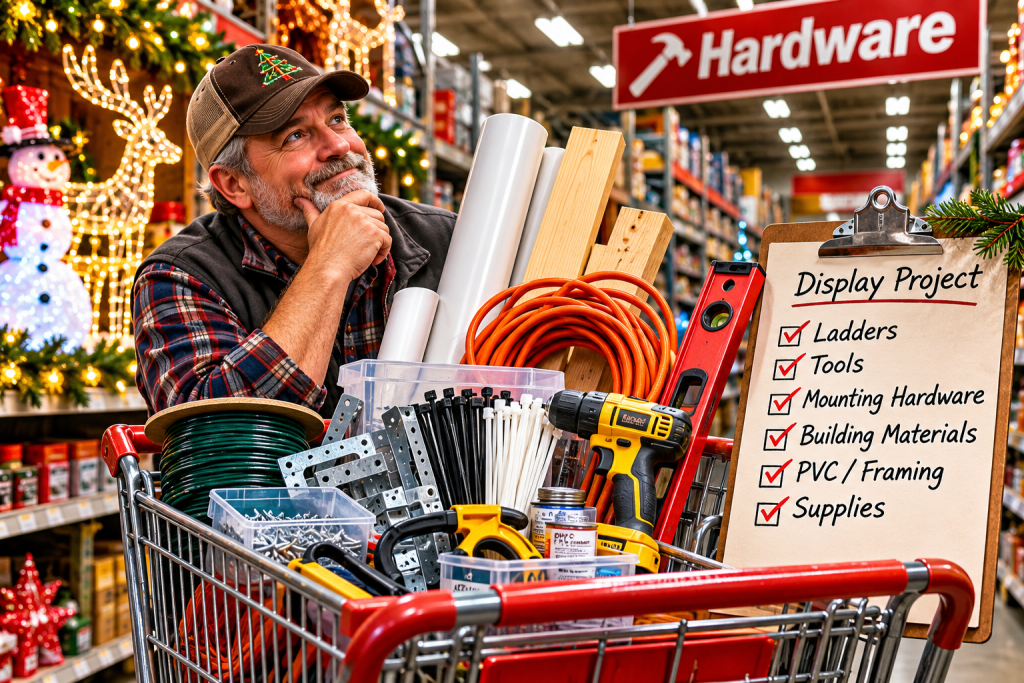
When most people think about the cost of decorating their homes for Christmas, they naturally focus on the decorations themselves. A box of lights costs a certain amount, an illuminated Santa has a price tag, and a new inflatable snowman might be a little more than you planned to spend. Add everything together, and you have a pretty good idea of what your display will cost. Except you probably don’t.
The decorations are only the most visible part of the investment. Once you start putting everything together, you’ll discover all sorts of additional expenses that don’t contribute anything particularly exciting to the finished display. Extension cords are a perfect example. They’re not glamorous, nobody comes to see them, and they can be surprisingly expensive when you need enough to reach decorations scattered throughout the yard. Outdoor-rated electrical connections, power distribution equipment, timers, mounting clips, stakes, zip ties, and other supplies can quickly add hundreds of dollars to a project.
Then there’s the equipment needed to install everything. Ladders, tools, mounting hardware, and materials for building custom decorations may all become part of the process. Many of these things can be reused for years, which helps justify the expense, but they’re still purchases that have to be made. And if you start building your own props, you may discover that a trip to the hardware store can be every bit as dangerous to your wallet as a visit to the Christmas aisle.
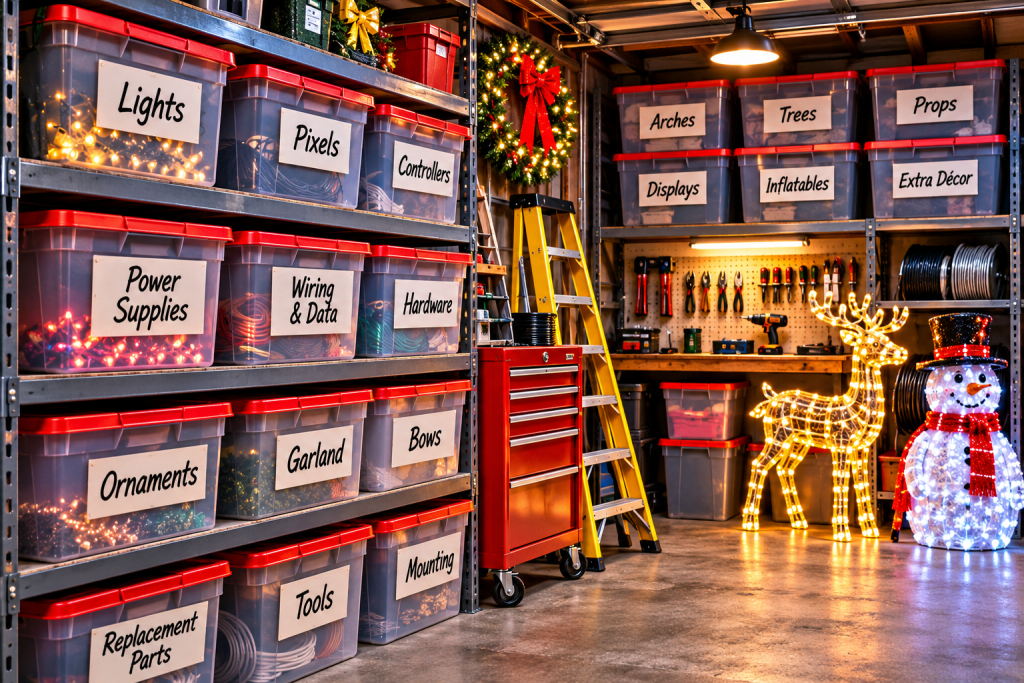
Storage is another consideration that doesn’t receive much attention until you’ve accumulated enough decorations to create a problem. Everything that goes into the yard in November has to go somewhere in January. Plastic totes, shelving, protective containers, and the space required to store everything can become significant considerations as a display grows. At Johnson’s Christmas Corner, we’ve certainly accumulated our share of Christmas equipment over the years, particularly as we’ve moved through several generations of lighting technology.
None of these expenses is particularly exciting, but they’re necessary. You can purchase the most beautiful decorations imaginable, and they won’t do much good if you can’t safely install them, provide electricity, or protect them when the season ends. A realistic decorating budget needs to account for the entire project, not simply the things visitors will eventually see.
When Decorating Becomes a Technology Hobby
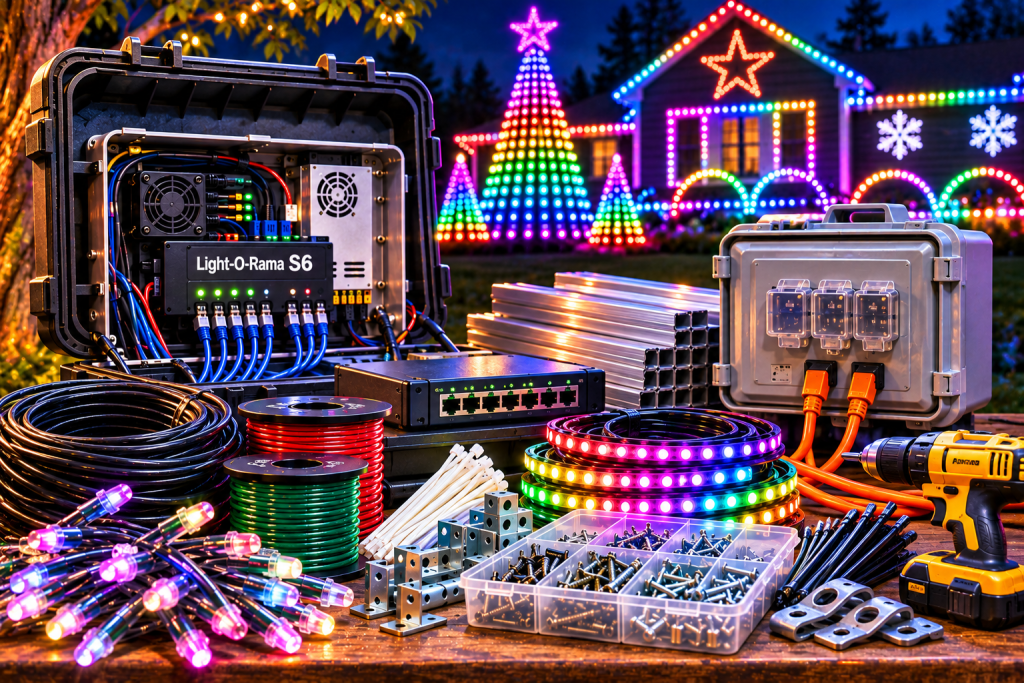
There’s a fairly significant financial difference between decorating your house with traditional Christmas lights and creating a computerized display synchronized to music. Both can produce wonderful results, but once you introduce animation, you’re dealing with equipment and technology that go well beyond what you’ll find in the seasonal aisle at your local department store.
When we began using Light-O-Rama at Johnson’s Christmas Corner in 2007, it opened up an entirely different approach to decorating. Instead of simply turning lights on and off with a timer, we could control individual sections of the display and synchronize them to music. That introduced all sorts of creative possibilities, but it also meant purchasing controllers, communication equipment, and other components that weren’t necessary for a traditional static display.
As the technology evolved, so did the equipment. LEDs offered greater efficiency and new decorating possibilities, while individually addressable RGB pixels introduced an entirely different level of control. Today, a single pixel tree can display colors, patterns, and animated effects that would have required considerably more complicated arrangements using older technology. It’s fascinating stuff, especially if you enjoy experimenting with computers and electronics, but the price of the pixels themselves is only part of what you’ll spend.
A pixel installation also needs controllers, power supplies, wiring, mounting materials, and sometimes specialized networking equipment. Depending on the design, you might need enclosures to protect electronics from the weather, additional electrical distribution, or custom-built structures to hold everything in place. While there are ways to build relatively inexpensive animated displays, larger projects can easily involve thousands of dollars in equipment before you’ve programmed the first song.
There’s also a learning curve that shouldn’t be overlooked. Computerized lighting requires an understanding of how the equipment communicates, how the various components work together, and how to create the sequences that bring everything to life. Some decorators absolutely love that technical side of the hobby. Others discover that they enjoy the finished result considerably more than they enjoy figuring out why a controller isn’t communicating with the computer.
Neither approach is wrong, but it’s worth knowing which kind of decorator you are before investing heavily in equipment. If you love technology and the creative challenges that come with it, animated lighting can become an incredibly rewarding hobby. If your idea of Christmas decorating involves hanging lights, plugging them in, and enjoying the view, there’s absolutely nothing wrong with sticking to that approach.
How Much Does a Christmas Display Really Cost?
This is probably the question people are most interested in, and unfortunately, it’s also one of the hardest to answer with a single number. Christmas displays vary enormously in size, complexity, and equipment, so what one person spends may bear little resemblance to another person’s budget. A modest display on a small home might require only a few hundred dollars, while a large computerized installation can represent an investment of many thousands.
To put things into perspective, imagine someone starting with a $500 decorating budget. That amount might cover a roofline, some illuminated landscaping, and a handful of decorations, particularly if the homeowner already owns basic installation supplies. It’s enough to create an attractive display when the purchases are carefully planned, although it probably won’t go very far if the goal is to cover every tree, bush, and architectural feature.
Increase the budget to $1,000 or $1,500, and considerably more becomes possible. Depending on the property and the equipment selected, that might allow for additional roofline lighting, several decorated trees, custom elements, or perhaps the beginnings of a small computerized lighting system. But even at that level, the money can disappear surprisingly quickly once electrical supplies, mounting materials, and other supporting equipment are included.
At the more elaborate end of the hobby, spending can reach five figures, particularly when a display incorporates extensive pixel networks, custom-built props, multiple controllers, and sophisticated animation. Some residential installations represent investments accumulated over decades, with equipment purchased, replaced, and upgraded across many Christmas seasons. Looking at one of those displays and assuming the owner spent that entire amount in a single year would be misleading. These examples aren’t intended to establish what anyone should spend. They’re simply illustrations of how quickly the financial commitment can change depending on the kind of display you’re trying to create. The same amount of money that produces an impressive traditional display might only cover a portion of the equipment required for a more ambitious computerized project.
There’s also a distinction between the total value of a display and its annual cost. If someone has accumulated $10,000 worth of decorations and equipment over fifteen years, that doesn’t mean they’re spending $10,000 every December. Much of that equipment may continue working for years, and spreading purchases across multiple seasons makes larger projects far more manageable. Of course, that assumes you can resist buying something new every year, which brings us to another problem.
The Display Is Never Really Finished
One of the interesting things about Christmas decorating is that there always seems to be something else you could add. Maybe the roofline looks terrific, but the trees need more attention. Perhaps you’ve finally finished decorating the front yard and suddenly realize the garage looks rather plain. Or you see an incredible new lighting effect online and start wondering whether you could incorporate something similar into your own display. The temptation to expand is understandable, particularly when decorating becomes a serious hobby. You’re constantly learning new techniques, discovering new products, and finding inspiration from other decorators. Unfortunately, that also means the amount you’ve already invested doesn’t necessarily reduce your desire to spend more.
Sometimes the purchases are perfectly reasonable. Equipment eventually wears out, older technology becomes difficult to maintain, and replacing something with a more efficient or reliable alternative can make sense. Other purchases are harder to justify. That new decoration might look fantastic, but if it doesn’t fit anywhere in your existing design, you may have just spent money on something that’s going to spend the next several years sitting in storage.
I’ve certainly made that mistake. In an earlier article, I talked about how my approach to decorating changed over the years, particularly when I realized that constantly adding more wasn’t necessarily making the display better. Part of that realization involved becoming more selective about what I purchased and recognizing that not every interesting idea needed to become a project. There’s another financial consideration that comes with expansion. Adding a new feature can create expenses beyond the original purchase. A new pixel prop might require another controller, additional power supplies, more wiring, and a different mounting arrangement. What began as a relatively affordable addition can become a much larger investment once everything necessary to make it work is included.
That doesn’t mean you should stop expanding. For many decorators, developing new ideas and improving the display from one year to the next is a major part of the enjoyment. But there’s a difference between expanding because you have a worthwhile idea and expanding simply because you feel the display needs to be bigger every Christmas. The first approach usually leads to better decisions. The second can get expensive in a hurry.
What About the Electric Bill?
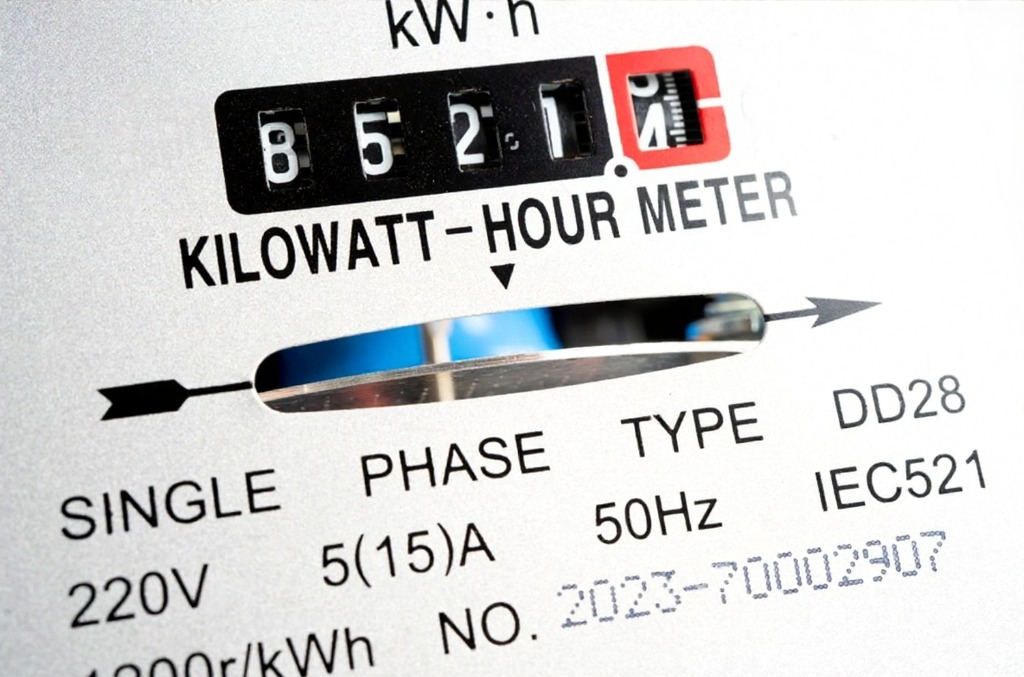
If there’s one expense that seems to capture everyone’s attention, it’s electricity. People see a house covered in thousands of Christmas lights and immediately imagine an enormous electric bill arriving in January. Years ago, when incandescent lights dominated residential displays, that concern was often well justified. Traditional incandescent bulbs consumed considerably more electricity than the LED products available today. Modern LED lighting has changed the equation dramatically. A display using thousands of efficient LEDs can consume far less electricity than a much smaller installation using older incandescent technology. Pixels also benefit from LED efficiency, although their actual consumption depends on factors such as brightness, color, and how many pixels are illuminated at any given moment.
For a simple example, imagine a display that averages 1,000 watts while operating. If it runs four hours each evening for thirty nights, it will consume approximately 120 kilowatt-hours of electricity. At an illustrative electricity rate of fifteen cents per kilowatt-hour, that works out to about $18 for the month. Double the average power consumption, and the cost would be approximately $36 under the same conditions.
Naturally, those figures are only examples. Actual costs depend on your equipment, operating schedule, utility rates, and how the display is programmed. An animated display that frequently dims or turns off sections of lighting may consume considerably less electricity than its maximum rated power would suggest. On the other hand, a large installation running at high brightness for extended periods can still use a substantial amount of power.
The important thing is to understand what your equipment actually consumes rather than assuming that a large number of lights automatically means an enormous electric bill. For many modern displays, the electricity required to operate everything may be relatively modest compared with the money invested in purchasing and installing the equipment. One area where saving money should never take priority, however, is electrical safety. Outdoor lighting needs appropriately rated equipment, proper circuit protection, and connections suitable for the environment. Trying to stretch electrical capacity beyond safe limits or cutting corners on installation materials is never worth the risk, regardless of how much money it might save.
The Expense That Doesn’t Appear on a Receipt
We’ve spent a lot of time talking about money, but there’s another cost that can become just as significant. It’s one that doesn’t show up on a credit card statement, and it’s remarkably easy to underestimate when you’re planning a new project.
Your time.
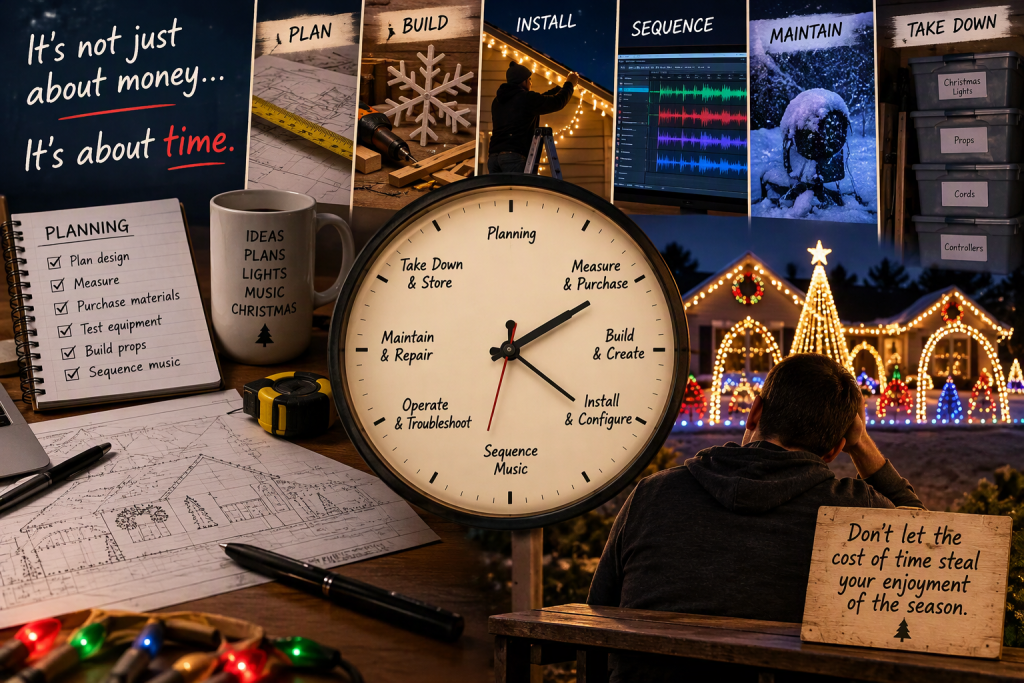
Consider everything involved in preparing a display. Before anything gets installed, there’s planning, measuring, purchasing, testing, and sometimes building decorations from scratch. Once installation begins, there are lights to hang, props to position, electrical connections to make, and equipment to configure. If you’re creating an animated display, sequencing music can become an entirely separate project that takes weeks or months of work. And the work doesn’t necessarily stop when the display opens. Equipment occasionally fails, weather creates problems, and decorations need attention throughout the season. Then January arrives, and everything has to come down, be packed away, and return to storage. Somehow, taking everything down never seems quite as exciting as putting it up.
For someone who genuinely enjoys the process, those hours can be time well spent. I’ve always enjoyed the creative side of sequencing music, imagining how the lights might respond to a particular song and gradually turning those ideas into something people can experience. But enjoying the work doesn’t mean there aren’t limits to how much of it you can reasonably take on. I wrote previously about reaching one of those limits in 2016, when I stood in the yard looking at everything that still needed to be installed and realized I wasn’t enjoying the process anymore. That experience eventually led me to reconsider how I approached decorating and what I wanted the display to be. It wasn’t simply a matter of money, but the time and effort required had become part of a commitment that was no longer providing the same enjoyment.
That’s an important consideration for anyone planning an elaborate display. The financial investment may be manageable, but the hours required to build, operate, and maintain everything can affect family time, other responsibilities, and your ability to enjoy the Christmas season yourself. There’s little benefit in creating a wonderful holiday experience for everyone else if the process leaves you too exhausted or frustrated to appreciate it.
Getting More Christmas Without Spending More Money
Here’s where everything we’ve discussed in the previous articles becomes particularly useful. Creating a better Christmas display doesn’t always require purchasing more equipment. In fact, some of the most effective improvements involve changing how you use the decorations you already own. Think about the role that arrangement, color, and visual balance play in a display. A few carefully positioned decorations can create a stronger impression than a much larger collection scattered throughout the yard. Lighting a tree properly can make it a focal point, while moving an existing decoration into a better position can completely change how an area looks. Sometimes removing something that doesn’t fit the overall design is more effective than adding another element.
The same principle applies to animated displays. A well-designed sequence doesn’t need every light operating at full brightness throughout an entire song. Using contrast, timing, and carefully selected effects can make the existing equipment far more interesting. A moment when only a few elements are illuminated can be just as effective as one where the entire house comes alive.
This is one reason I’ve emphasized thoughtful design throughout this series. When you understand what you’re trying to create, you can make better decisions about where your money should go. Instead of purchasing something simply because it looks impressive, you can consider whether it will actually improve the experience. There’s also considerable value in taking your time. Building a display over several seasons allows you to spread out expenses, learn from previous years, and make adjustments before committing to additional equipment. It gives you an opportunity to discover which parts of decorating you enjoy most and which investments provide the greatest benefit.
And don’t overlook the value of maintaining what you already own. Proper storage, careful handling, and routine equipment checks can extend the useful life of decorations and reduce the need for replacements. Those habits may not be particularly exciting, but they can make a substantial difference in the long-term cost of the hobby.
Knowing What Christmas Is Worth to You
It’s tempting to approach Christmas decorating as though there’s some ideal amount of money everyone should spend. In reality, that number is going to be different for every household. Someone with a modest budget and a love of traditional decorations may be perfectly happy spending a few hundred dollars. Another person might consider a substantial investment in computerized lighting worthwhile because designing and programming the display has become one of their favorite hobbies. Neither person is necessarily making a better financial decision. What matters is whether the spending fits their circumstances and whether they’re getting enough enjoyment from the experience to justify the commitment.
I also think it’s important to recognize that the value of a Christmas display isn’t always something you can measure financially. There are memories associated with decorating, family traditions that develop over time, and the satisfaction of creating something other people enjoy. Those things have value, even if they don’t appear on a spreadsheet.
But that doesn’t mean the financial side should be ignored. It’s entirely possible to love Christmas decorating and still spend more than you should. It’s possible to become so focused on improving a display that you lose sight of the time, money, and effort required to maintain it. And it’s possible to reach a point where the commitment begins to outweigh the enjoyment. Recognizing those possibilities doesn’t make someone less enthusiastic about Christmas. It simply means they’re approaching the hobby with a realistic understanding of what it requires.
After more than twenty years of decorating our home in Texas, I’ve learned that there’s always another idea to consider, another decoration that catches my eye, and another improvement I’d love to make. Some of those ideas eventually become part of Johnson’s Christmas Corner. Others remain on the wish list, sometimes for years. And I’ve become perfectly comfortable with that because I’ve learned that our display doesn’t have to get bigger every Christmas to continue being something special.
Throughout this series, we’ve explored ways to make Christmas displays more memorable, from choosing a theme and improving the design to understanding what makes people slow down, smile, and stay. None of those things necessarily requires spending more money. Often, the biggest improvements come from making better use of what you already have.
Ultimately, it comes down to understanding what you want your display to accomplish, what you’re willing to invest, and how much enjoyment you get from creating it. There’s nothing wrong with building something elaborate, just as there’s nothing wrong with keeping things simple. The important thing is making sure the time, money, and effort remain worthwhile.
After all, the goal was never to have the most Christmas lights in the neighborhood. It was to enjoy Christmas and share a little of that enjoyment with everyone else.