“We’ve Always Done It This Way”
There is a saying I have used at JAX Creative for years: “The most dangerous phrase in any language is, ‘We’ve always done it this way.’” I have always loved that idea because those six words can quietly kill experimentation. They suggest that the way something has been done is somehow evidence that it is the way something should be done.
And if there is one hobby where “we’ve always done it this way” should probably be thrown out with the burned-out strings of incandescent lights, it is Christmas lighting. The truth is, we have never always done it one way. Nearly everything we take for granted in a modern Christmas display exists because somebody looked at the way everyone else was doing something and thought, There has to be another way.
And now artificial intelligence has entered the holiday workshop.
Here We Go Again
AI has become one of those subjects where it can sometimes feel like everyone is expected to choose a side. There are the utilization people who are experimenting with it, figuring out where it can save time, solve problems, or help create something new. Then there are people who want absolutely nothing to do with it. Depending on whom you ask, AI is either an incredible new tool or the beginning of the end of human creativity.
Naturally, Christmas lighting wasn’t going to escape that argument. We’re already beginning to see discussions about using AI for sequencing, programming, designing props, writing scripts, analyzing music, creating effects, troubleshooting equipment, and probably a dozen other things somebody will think of before I finish writing this article. Some people think that’s exciting. Others hear “AI sequencing” and immediately worry about what happens to the creativity that has always been at the heart of this hobby.
That’s a fair question. If a computer eventually becomes capable of analyzing a song, selecting effects, assigning them to props, choosing colors, and producing a completed sequence, where does the person fit into the process? I think that’s absolutely worth talking about. But before we decide technology is about to destroy Christmas lighting, we should probably take a little trip through Christmas lighting history.
Because we’ve had this relationship with technology for a very long time.
Remember When Lights Were Just Lights?
Christmas lights used to be pretty simple. We had big incandescent bulbs. They were bright, colorful, hot enough to cook dinner on, and they consumed enough electricity that decorating the house could become an exercise in figuring out which circuit breaker you were willing to sacrifice. Then miniature incandescent lights became popular, and suddenly we could put hundreds and eventually thousands of lights into a display much more easily.

Then came LEDs. They used less electricity, produced less heat, lasted longer, and allowed decorators to build displays that would have been much more difficult to power with traditional incandescent lights. Eventually pixels changed everything again. A string of lights was no longer necessarily a string of lights. Each individual pixel could become its own controllable light source, with its own brightness and color.
Think about how enormous that change really was. We went from deciding whether a string of lights was on or off to controlling thousands of individual points of light in millions of possible colors. We could create movement, patterns, images, video-like effects, and displays that would have been nearly unimaginable to the person decorating with C9s several decades earlier.
Technology didn’t eliminate the creative part.
It gave us a bigger canvas.
We Didn’t Always Have Controllers Either
The same progression happened behind the scenes. Once upon a time, a timer was technology. Plug your Christmas lights into one of those little mechanical boxes, push down the tabs for the hours you wanted the display running, and congratulations, you had automated Christmas.
Decorators eventually started experimenting with relays and other methods of controlling different sections of their displays. Later, dedicated lighting controllers put sophisticated computerized lighting control within reach of ordinary hobbyists. Systems such as Light-O-Rama allowed us to control individual channels from a computer and synchronize those channels to music.
That was an enormous technological shortcut compared with what came before it, but we certainly didn’t think of it that way. We thought it was amazing. It allowed us to do something we couldn’t do before, so we embraced it, learned it, experimented with it, and naturally found ways to make it increasingly complicated.
Of course, once we could control all those channels, we immediately created another problem for ourselves. Somebody had to sequence them.

Remember Tapping Out Beats?
For many of us, sequencing involved sitting in front of a computer, listening to a song, and tapping along with it to create timing marks. Beat after beat after beat, we built the framework that allowed us to decide when something in the display should happen.
Then software developers started giving us tools to make that job easier. Beat wizards appeared. Timing analysis improved. Effect generators became more sophisticated. SuperStar gave decorators new ways of creating complicated effects, while programs such as xLights pushed effect generation and pixel sequencing even further. Today, software can accomplish things in seconds that once required an enormous amount of manual work.
And somehow we survived.
Nobody stands in front of a beautiful synchronized Christmas display and asks whether the person manually tapped every beat in the song. At least I hope they don’t. We accepted those tools because they helped us get from an idea to a finished display, and I think that history matters when we start talking about AI.
Even the Stuff in the Yard Changed
Look around the yard and you’ll find the same story. Plastic blow molds were once a staple of Christmas decorating, and plenty of people still love and collect them. Homemade wooden cutouts became another way for people to personalize their displays. Wireframes followed, along with coroplast props, pixel props, motors, servos, pneumatics, animatronics, and combinations of all of them.

Construction methods evolved right along with the props. For years, building a mega tree often meant figuring out how to hoist a pole into the air, secure it, guy it properly, attach everything, and eventually reverse the entire process without sending a piece of metal through your neighbor’s roof.
Then people started looking for better ways to do it. Systems such as the Monkhouse JUMP are a perfect example. Other decorators designed hinged poles, winches, crank systems, portable bases, custom toppers, and all kinds of hardware intended to make construction easier and safer. Nobody took creativity out of building a mega tree by finding a better way to raise one.
Finding the better way was part of the creativity.
So What Could AI Actually Do?
That’s what makes AI interesting to me. I don’t particularly want artificial intelligence to make my Christmas display for me. Frankly, that sounds incredibly boring. What interests me is whether AI can eliminate some of the grunt work that exists between having an idea and actually creating it.
Imagine giving an AI-assisted system a piece of music and having it identify beats, percussion hits, vocals, tempo changes, musical phrases, crescendos, transitions, and major accents. Instead of spending hours building the musical roadmap, the sequencer could begin with one and decide what to do with it. Maybe the system could eventually analyze existing sequences and recognize patterns in the way a particular person works. It might notice that certain props tend to follow percussion, another group often handles vocals, or particular effects are commonly used during large musical builds. From there, it could make suggestions that the person sequencing could use, change, or completely ignore.

That’s the distinction I think gets lost sometimes. A suggestion isn’t creativity, just as a beat wizard isn’t creativity. The creative part is deciding what to do with the information the tool gives you.
There are plenty of other possibilities. AI could potentially help generate timing tracks, suggest color palettes, create effect variations, identify repetitive sequencing tasks, organize channel assignments, troubleshoot controller configurations, calculate power requirements, or convert information between formats. It could also help bridge technical gaps. Maybe you know exactly what you want a small piece of software to do but couldn’t write a line of Python if your Christmas display depended on it. AI might help you build that tool.
Or maybe you’ve spent three nights trying to figure out why one piece of hardware refuses to communicate with another and you’re approximately fifteen minutes away from introducing both of them to a hammer. If AI can help with that, I think we can all agree that it has at least one socially redeeming quality.
The Young Whippersnappers Have More Toys
AI isn’t arriving alone. Look around the Christmas lighting community today and you’ll find technology that would have seemed like science fiction to hobbyists not very long ago. 3D printers are sitting on workbenches making custom brackets, clips, spacers, enclosures, adapters, replacement parts, mounting systems, and pieces for entirely new props.
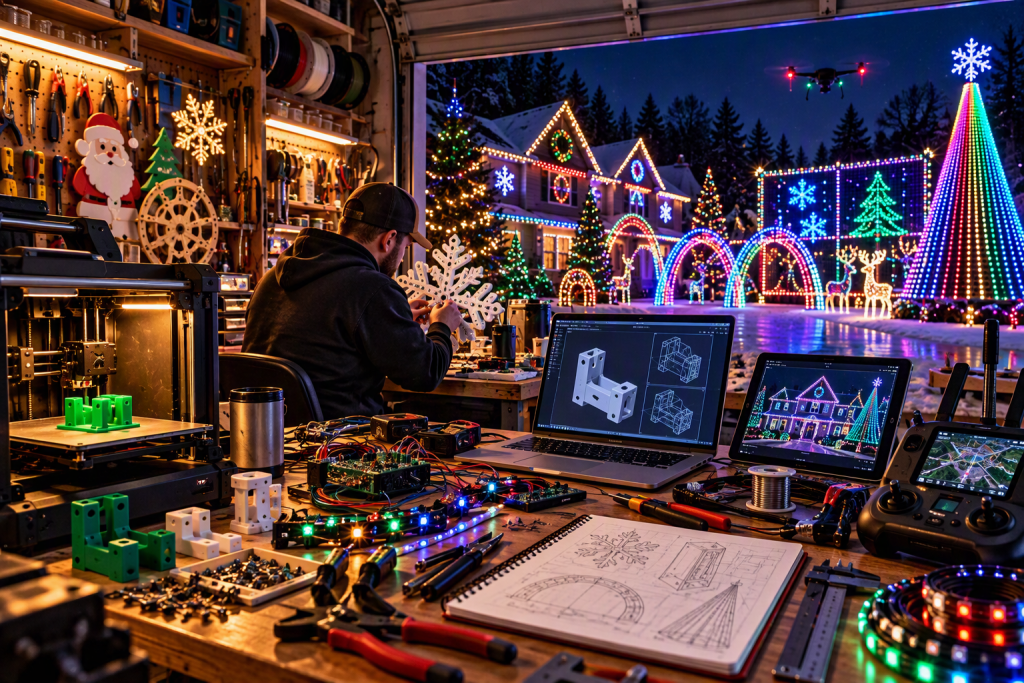
CNC routers and laser cutters allow hobbyists to manufacture incredibly precise components in their garages. Microcontrollers make it possible to build custom electronics and automated props. Wireless networking has changed how equipment communicates, while projection mapping can transform the architecture of a house into part of the show. Affordable design software lets us model things before we build them, and drones let us photograph and video displays from perspectives that once would have been nearly impossible for the average hobbyist.
Somewhere right now, I’m sure some Christmas lighting nut is combining three or four of those technologies into something none of us has seen before. And that’s a good thing! Because that’s how this hobby moves forward.
Easier Doesn’t Mean Less Creative
This is where I think the argument over AI can go off the rails. There is an assumption that if technology makes part of the creative process easier, the finished product somehow becomes less creative. But if that’s our standard, we’re going to have to throw out an awful lot of things we’ve happily adopted over the years.
LEDs made certain things easier. Controllers made things easier. Sequencing software made things easier. Beat wizards made things easier. Coroplast made certain props easier to build. Pixels made effects possible that would have been extraordinarily difficult with traditional strings. SuperStar and xLights made complicated sequencing easier. The JUMP made raising a mega tree easier. A 3D printer makes manufacturing a custom part easier.
Yet we don’t generally argue that someone should abandon all of those things because suffering through the difficult version somehow makes the finished display more authentic. We use tools because tools help us create things. The tool isn’t the creativity. The choices are.
Give two people the exact same lights, controllers, software, props, music, and tools and I can almost guarantee they will create two very different displays. Their personalities, musical tastes, sense of timing, color choices, humor, traditions, and ideas will find their way into the finished product. AI doesn’t have to change that.
That Doesn’t Mean Every Concern Is Wrong
None of this means every concern about AI should be dismissed. There are legitimate questions involving ownership, copyright, training data, originality, and what happens when people begin passing machine-generated work off as entirely their own. Those conversations matter, and the technology is changing quickly enough that we’re probably going to be having them for a long time.
I also think there’s a difference between using AI as a creative tool and asking AI to do absolutely everything for you. If somebody eventually types “Make me a Christmas sequence,” accepts whatever appears, never changes anything, and doesn’t contribute a single creative decision, I personally don’t find that particularly interesting.
But that’s where I have to remind myself of something too. It’s their display. I don’t get to make the rules for their hobby any more than they get to make the rules for mine.

Your Christmas Is Still Yours
If you don’t trust AI, don’t use it. If using AI takes away the part of sequencing you enjoy most, don’t use it. If you love manually placing every single effect, keep doing it. On the other hand, if you want to use every wizard, assistant, script, automation tool, and artificial intelligence system you can find, have at it.
If your dream Christmas display consists of 100,000 pixels dancing to music, build it. If your dream display is a plastic Santa, three strands of C9 bulbs, and the same wooden reindeer your father put in the yard when you were a kid, that’s pretty wonderful too. This hobby has room for both, along with just about everything in between.
What we shouldn’t do is confuse our preferred way of enjoying the hobby with the correct way to enjoy the hobby. None of us invented Christmas lighting. None of us owns it, and none of us has the corner on creativity. We certainly shouldn’t make someone else feel bad about their contribution simply because they used a tool we wouldn’t have chosen ourselves.

Maybe We Need Some New Wineskins
There is something wonderfully appropriate about finding a final thought for a Christmas lighting discussion in Scripture.
In Mark 2:21-22, Jesus talks about the problem of sewing new cloth onto an old garment. The new patch can pull away and make the tear worse. He then uses another example, putting new wine into old wineskins. The expanding wine can burst the old skins, ruining both. He concludes with the simple image, “But new wine is for fresh wineskins.”
Obviously, Jesus wasn’t giving us advice about pixels, sequencing software, or artificial intelligence. But there is something in that imagery that I think applies here. Sometimes something new doesn’t fit comfortably into the framework we’ve always used. Trying to force it into that framework doesn’t necessarily protect what came before. Sometimes we have to be willing to rethink the framework itself.
Maybe AI becomes an important part of Christmas lighting. Maybe it doesn’t. Maybe five years from now we’ll laugh at what we thought AI could do in 2026 because the technology has advanced so dramatically. Maybe we’ll discover there are certain parts of sequencing where the human touch simply can’t be replaced. Most likely, we’ll discover AI is incredibly useful for some things and completely useless for others.
We don’t know yet, and that’s precisely why I think experimenting with it is worthwhile.
Use AI or don’t. Buy a 3D printer or keep cutting things out of plywood. Sequence every beat yourself, use a wizard, write a script, or buy a sequence. Build a pixel mega tree with the newest hardware you can find, or put that forty-year-old plastic Santa back in the front yard.
Enjoy your hobby and your creativity, and give the person next to you enough room to enjoy theirs. Let’s keep experimenting, building, and sharing what works and what doesn’t. Let’s help the newcomer who has no idea what they’re doing, and let’s learn from the person who just figured out something none of us had thought of before.
Because this hobby didn’t get from incandescent C9s and mechanical timers to pixels dancing across houses by doing everything the way it had always been done.
And let’s be honest. “We’ve always done it this way” doesn’t sound much like us anyway.