Why Your Lights Don’t Feel “Magical”
There’s a moment that almost every Christmas decorator experiences sooner or later. You’ve spent the weekend hanging lights, arranging decorations, untangling extension cords, and making at least three trips to the store for something you were absolutely certain you already had. Finally, the sun goes down, the lights come on, and you step back to admire your work. Everything is working, the house is decorated, and the yard is glowing. By any reasonable definition, you’re ready for Christmas. Yet something doesn’t seem quite right. You can’t necessarily explain what’s missing, but the display doesn’t look the way you imagined it would.
Maybe you’ve driven through neighborhoods and seen houses that seem to have that special something. They aren’t necessarily the biggest displays, and some don’t even have as many decorations as yours. But there’s something about them that makes you slow down and take another look. Meanwhile, you’re standing across the street from your own house wondering why several hundred dollars’ worth of Christmas decorations hasn’t produced quite the same feeling. The good news is that the answer probably isn’t another shopping trip. Sometimes the difference between a display that looks decorated and one that feels magical comes down to a few things you may not have considered.
Sometimes Less Really Is More
One of the easiest traps to fall into when decorating for Christmas is believing that every empty space needs something in it. There’s an open spot beside the driveway, so you put a snowman there. The bushes look a little bare, so you add another strand of lights. Then you notice a gap between two decorations and decide it would be the perfect place for that illuminated reindeer you bought on clearance last January. Before long, you’ve managed to fill nearly every available inch of the yard, but instead of looking more impressive, the display somehow looks smaller. Individual decorations disappear into everything surrounding them, and there’s so much happening that nothing really catches your attention.
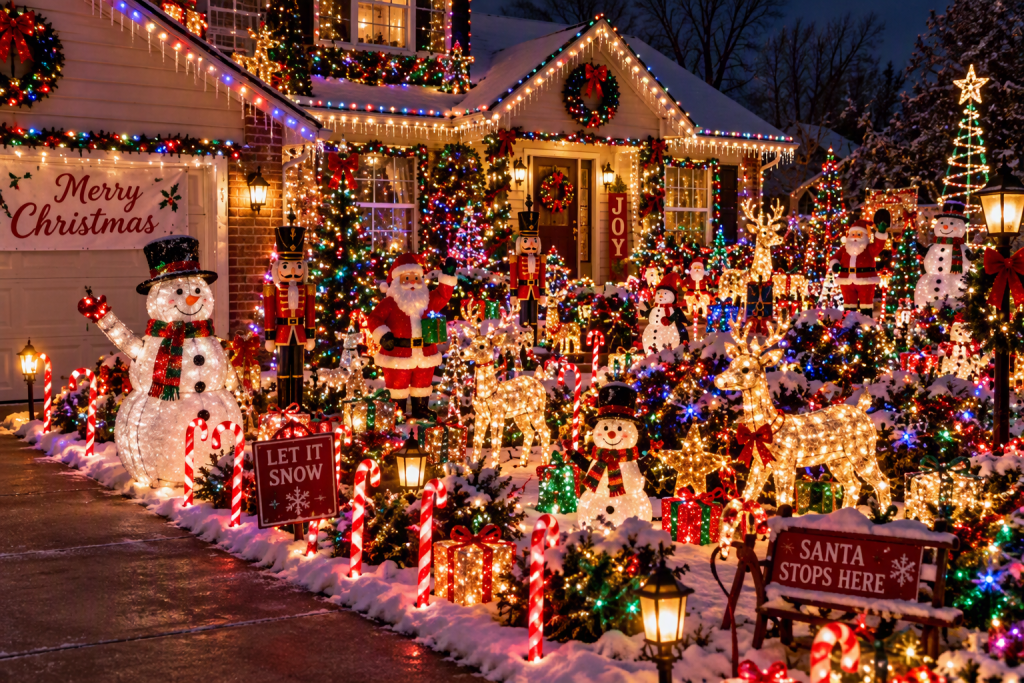
Think about the Christmas tree inside your house. Most of us have ornaments that are particularly special, perhaps something a child made in elementary school or a decoration that’s been in the family for generations. If every branch is covered with ornaments, ribbons, garland, and lights, those meaningful pieces can get lost. The same principle applies outside, where giving decorations a little room can make them much more noticeable. This doesn’t mean you need to embrace some minimalist Christmas decorating philosophy. If your idea of Christmas is a yard overflowing with Santas, snowmen, and reindeer, there’s absolutely nothing wrong with that. The trick is arranging things so visitors can appreciate what you’ve created rather than seeing everything as one enormous collection of lights.
Give People Something to Look At
When someone approaches your house, where do their eyes go first? It’s a surprisingly useful question, especially if you’ve never looked at your display from anywhere other than your driveway. Some houses have an obvious centerpiece, perhaps a beautifully decorated tree, a large Santa and sleigh, an illuminated nativity scene, or a particularly interesting architectural feature. Other displays have several smaller areas that naturally draw attention as someone looks across the property. Neither approach is necessarily better, but both give visitors something to discover.
The trouble begins when everything is competing for attention. Imagine a brightly illuminated inflatable beside a flashing decoration, with a colorful projection playing across the garage and several different lighting effects running nearby. Each might look terrific individually, but together they can become overwhelming. Sometimes moving one decoration, reducing the brightness of another, or creating a little separation between them makes an enormous difference. You haven’t purchased anything new, and you haven’t necessarily removed anything from the display. You’ve simply given people a better opportunity to enjoy what was already there.
It’s also worth remembering that people rarely see your display the same way you do. You’ve spent hours working on individual sections, so you know where everything is and what each decoration is supposed to look like. Someone driving past has only a few seconds to take it all in, and looking at your house from their perspective can reveal things you might otherwise overlook.
The Colors Don’t Have to Match, But They Should Get Along
Christmas is hardly a holiday known for restraint when it comes to color. Red, green, blue, gold, white, and just about everything in between have found their way into Christmas decorations over the years. Some people prefer the traditional appearance of warm white lights, while others love the bright multicolored displays they remember from childhood. Neither preference is right or wrong, and there’s certainly no rule requiring every strand of lights on your property to be the same color. In fact, some of the most charming displays we’ve seen combine colors and styles that wouldn’t necessarily appear together in a decorating magazine.
What can make a difference is how those colors are distributed. If one side of the house is covered in warm white lights while the other has several different shades of blue, the result might look unbalanced. A large concentration of bright red decorations in one corner can have a similar effect, particularly if the rest of the yard uses softer colors. That doesn’t mean you need to replace anything. Sometimes repeating a color in another part of the display helps tie things together, while other times simply moving a decoration creates a better balance. The goal isn’t to make everything match perfectly. It’s to make the different parts of the display feel like they belong to the same celebration.
Don’t Forget That Your House Has Three Dimensions
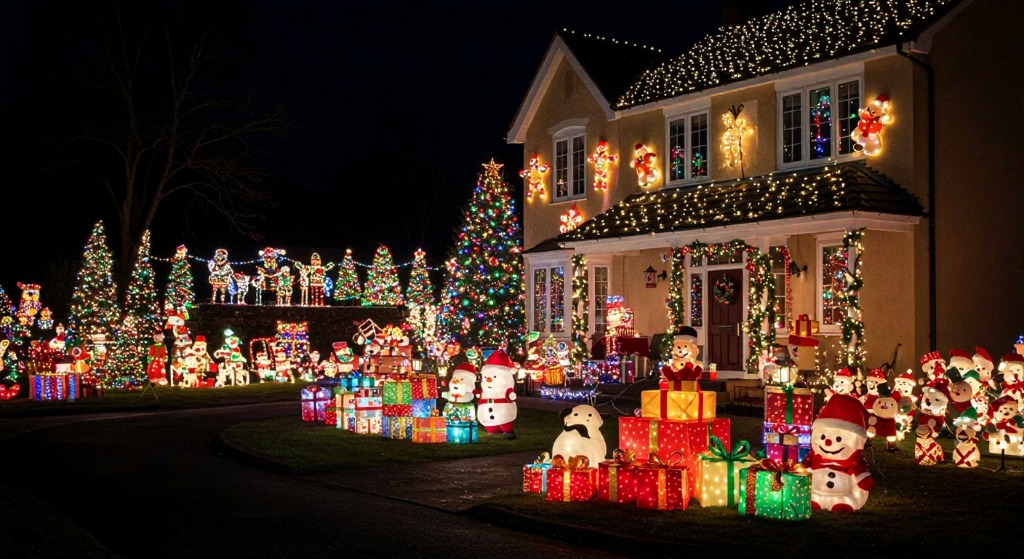
One of the things that can make a Christmas display feel incomplete is something most people don’t immediately recognize. The lights are beautiful, the decorations are attractive, and the colors work well together, but everything seems to be arranged along one flat surface. It’s easy to understand how this happens. Rooflines, windows, and gutters are obvious places to hang lights, so that’s where many people begin. A few decorations go in the yard, perhaps along the sidewalk or directly in front of the house, and suddenly the display is finished.
But look at the properties that really catch your attention. Often, they have something happening at different distances and heights. There may be decorations near the street, illuminated bushes closer to the house, and trees or architectural lighting rising behind them. Together, those elements create a sense of depth that makes the property feel larger and more interesting. You don’t need a huge yard to accomplish this, either. A small decoration near the walkway, lights around a tree, and a well-defined roofline can create several layers within a relatively modest space. Even changing the position of decorations you already own can make the display feel more complete.
Don’t overlook the natural features of your property when thinking about these possibilities. Trees, shrubs, columns, fences, and landscaping can become part of the design without requiring you to build elaborate structures or purchase specialized equipment. Sometimes the features that make a property interesting during the day are the very things that can make a Christmas display stand out after dark.
A Little Movement Can Go a Long Way
There’s something captivating about movement in a Christmas display. A rotating decoration, a gently twinkling tree, or lights that slowly fade between colors can draw attention in ways that static decorations sometimes don’t. It’s one reason animated Christmas displays have become so popular, although movement has been part of holiday decorating long before computerized light shows existed.
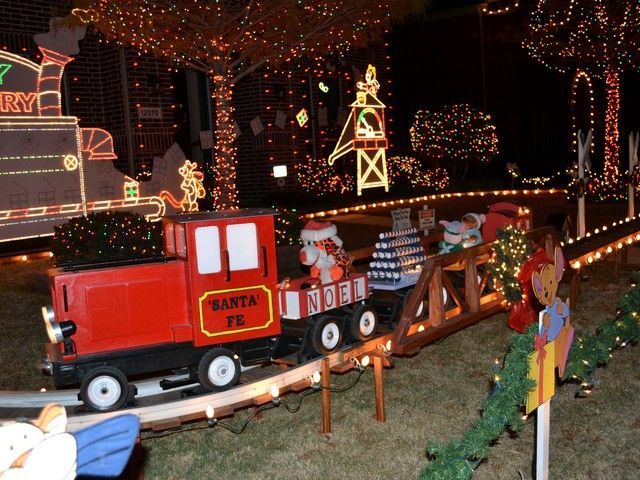
The important thing is recognizing that movement works best when it has a purpose. If every decoration is flashing, chasing, blinking, or changing colors independently, the result can become a little chaotic. Instead of enjoying the display, visitors may find themselves wondering where they’re supposed to look. You don’t need synchronized music or computerized controllers to experiment with animation, either. Even a few simple effects can add interest, particularly when they’re surrounded by steady lighting. The contrast between something moving and something remaining still often makes the movement more noticeable.
Of course, there’s nothing wrong with an entirely static display. Some of the most beautiful Christmas decorations we’ve encountered haven’t moved at all, and there’s something especially appealing about a quiet house glowing with traditional Christmas lights. Movement is simply another option, not a requirement for creating something special.
Sometimes the Magic Has Nothing to Do With the Lights
One thing that can get overlooked when people become focused on improving their Christmas displays is that the decorations themselves aren’t always what makes a display memorable. Think about the Christmas decorations you remember from childhood. Chances are, you don’t remember how many lights were on the house or whether the colors were perfectly coordinated. You remember a particular Santa, the glowing candles in the windows, the plastic snowman beside the porch, or the way the house looked when you came home on Christmas Eve. Those memories are powerful because they connect the decorations to something beyond their appearance.
At Johnson’s Christmas Corner, we’ve watched our own display change considerably since we started in 2005. Technology has evolved, decorations have come and gone, and what we can do today is very different from what we could do when we first began. Yet some of the most meaningful moments have had very little to do with the equipment or the number of lights. They’re the families who return year after year, the children who recognize something from a previous visit, and the conversations with people who tell us about the Christmas displays they remember growing up. Those experiences are reminders that the real value of a display isn’t always something you can photograph.
You may already have something in your display that creates that same connection. Perhaps it’s a decoration your family has used for years or something your children helped make. Maybe it’s a traditional nativity scene, a handmade sign, or a Santa that has become a neighborhood favorite. Don’t underestimate those things simply because they aren’t the newest or brightest decorations in the yard. Sometimes the decorations that mean the most are the ones that have been there the longest.
Take Another Look Before You Buy Anything Else
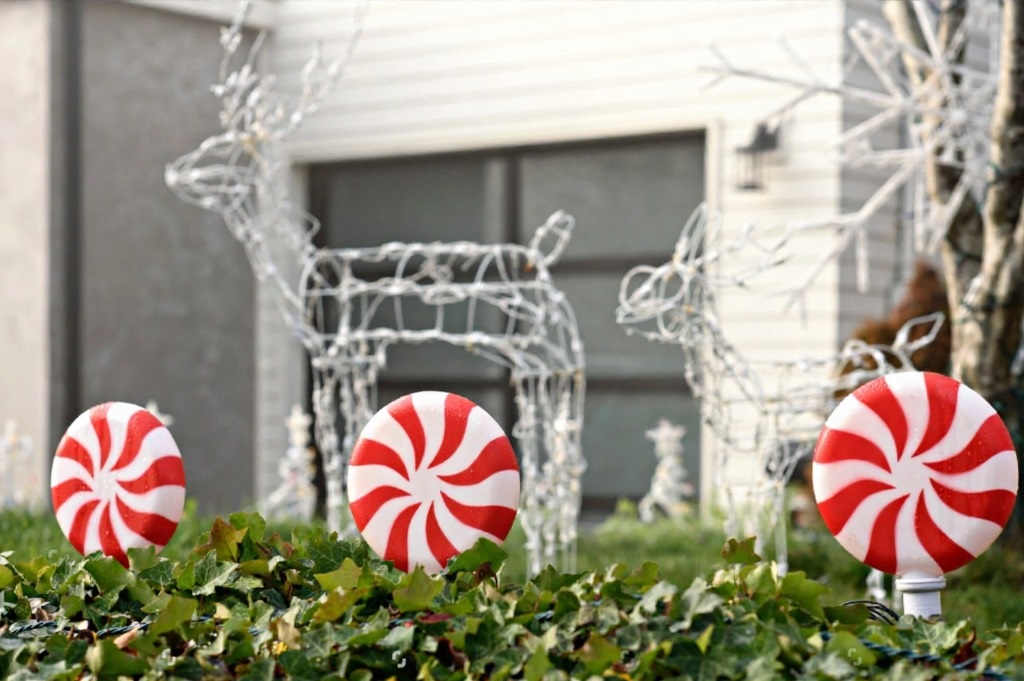
If you’ve reached the point where your Christmas display doesn’t look quite the way you’d hoped, resist the temptation to solve the problem by immediately buying more decorations. Instead, spend a little time looking at what you already have. Walk across the street after dark and look at the entire house. Take a few photographs, then compare what you see with what you had imagined. Is there an area that feels too crowded? Are certain decorations getting lost? Does one part of the yard seem disconnected from everything else? Would moving something create a better view or give another decoration more room to stand out?
You might discover that the changes you need are surprisingly small. A decoration moved to a different location, a few lights added to an existing tree, or a section simplified can completely change how the display feels. Sometimes the best improvement isn’t adding something at all, but finding a better way to use what you’ve already collected.

And remember, there’s no requirement that your Christmas display impress everyone who drives past. Some people love elaborate animated shows, while others would rather see a quiet house with warm white lights and a wreath on the door. Christmas means different things to different people, and the displays that reflect those differences are part of what makes driving through neighborhoods during the holidays so enjoyable.
The magic isn’t necessarily hiding in another box of lights or waiting on the clearance shelf after Christmas. More often, it’s already somewhere in the decorations, traditions, and memories you’ve been collecting all along. Sometimes all it takes is looking at them a little differently.
Watch for Our Next Article:
What We Would Do Differently If We Started Our Display Over Today