



Decking the Halls
The Merry History of Christmas Tree Decorating
There are few sights more cheerful than a Christmas tree adorned with twinkling lights and sparkling with ornaments. Illuminated in the dark winter nights, this festive symbol of happiness, family, and hope has a long and charming history. Join us as we explore the evolution of the Christmas tree from ancient tradition to cherished modern ritual!

Ancient Traditions: Evergreen Symbols of Life
Long before Christmas trees became a holiday tradition, many ancient cultures welcomed in the winter solstice with evergreens. Egyptians used palm fronds to celebrate the sun god, while Romans hung laurel and fir branches in their doors and windows. Celtic druids honored holly and mistletoe as symbols of life during the coldest, darkest days of winter. To all these people, the evergreen boughs meant survival — a message still echoed in our holiday season.
In the 16th century, devout Christians in Germany began bringing small fir trees into their homes and decorating them with apples, nuts, gingerbread, and candles. The lit candles reminded them of the light of Christ and the hope that even in the darkest of winters, life would return. Legend has it that Martin Luther first got the idea of adding candles to his tree when he saw the bright stars of the night sky shining through the evergreens.
Royal Trees & Global Customs
By the 1700s and 1800s, Christmas trees were popular throughout Europe in Austria, Switzerland, and France, each with their own national styles. In the 1700s, German immigrants began the tradition in North America, but it remained a regional, somewhat odd custom. However, in 1848, an engraving of Queen Victoria and her husband Albert gathered around a lavishly trimmed Christmas tree appeared in a London newspaper. The image was a sensation in both Britain and America, and the Christmas tree became a fashionable holiday must-have.

Simple Ornaments to Glittering Glamour
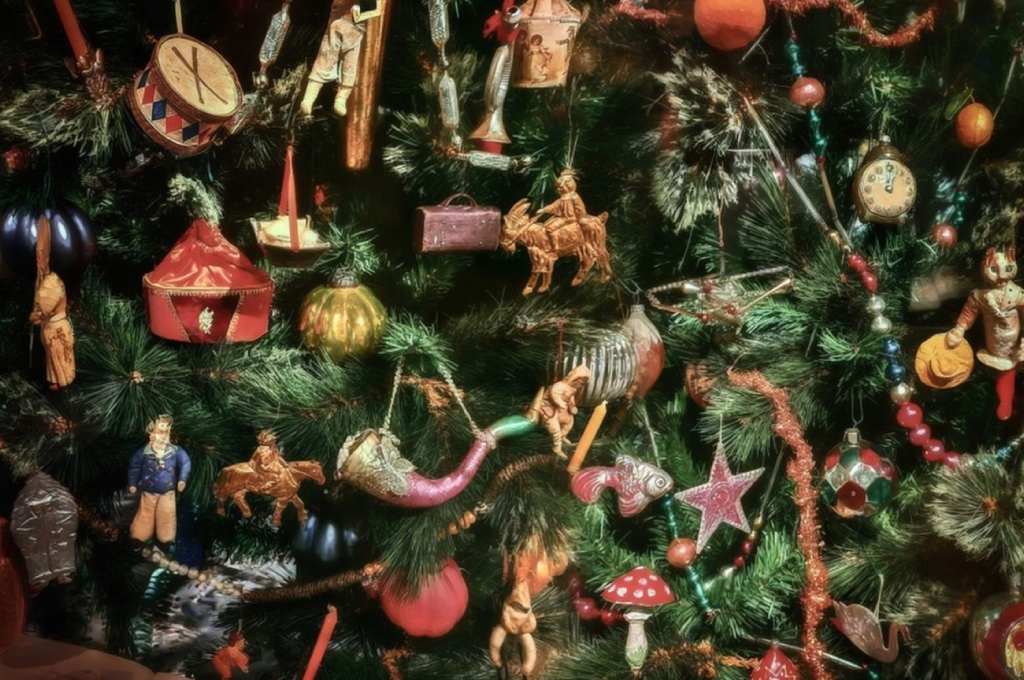
The earliest trees were trimmed with simple, natural or homemade items. Families hung strings of cranberries, cut-out paper snowflakes, gilded walnuts, and gingerbread cookies in the shape of stars and hearts. In the late 1800s, blown-glass ornaments became popular in Germany and spread across Europe and to the U.S. Soon after, the invention of electric Christmas lights in 1882 opened a dazzling new world of tree decorating. No longer limited to short-lived wax candles, families could keep their trees illuminated for weeks on end.
Tree Decorating Traditions Around the World
Today, each country and culture has its own unique customs for decorating Christmas trees:
- United States – Families often decorate their trees together after Thanksgiving. Ornaments include cherished heirloom pieces and handmade crafts as well as store-bought novelties.
- Germany – Traditionally, families decorate the tree on Christmas Eve, with candles, tinsel, and glass ornaments.
- Ukraine – Spider ornaments called pavuchky are thought to bring good luck and prosperity.
- Mexico – Trees are decorated with bright colors, ribbons, and nativity scenes nestled among the branches.
- Scandinavia – Straw ornaments, wooden figurines, and white candles celebrate a love of nature and simplicity.
Decorating With Joy

Nowadays, some families love the smell of a fresh-cut tree, while others prefer easy, reusable artificial versions. Decorating styles range from elegant, classic looks in red and gold to whimsical, themed decorations based on favorite movies, hobbies, or nature. Outdoor trees are strung with lights for town squares and village streets. Department stores have show-stopping displays of giant trees adorned with oversized ornaments. Apartment dwellers and dorm-mates can even celebrate the season with tiny tabletop trees.

Decorating Christmas trees is a joyful holiday tradition mixing history, artistry, and togetherness. Whether homemade by a child, ordered online, or passed down through the family for generations, each ornament has a story. Every strand of lights adds not just sparkle to the tree but to the hearts of everyone who gathers to enjoy its cheerful glow. From ancient evergreens to today’s holiday glittering, the Christmas tree is a symbol of hope, happiness, and magic.